Inverted Pyramid Management Principle: From Control to Empowerment, Reshaping Organizational Agility and Vitality

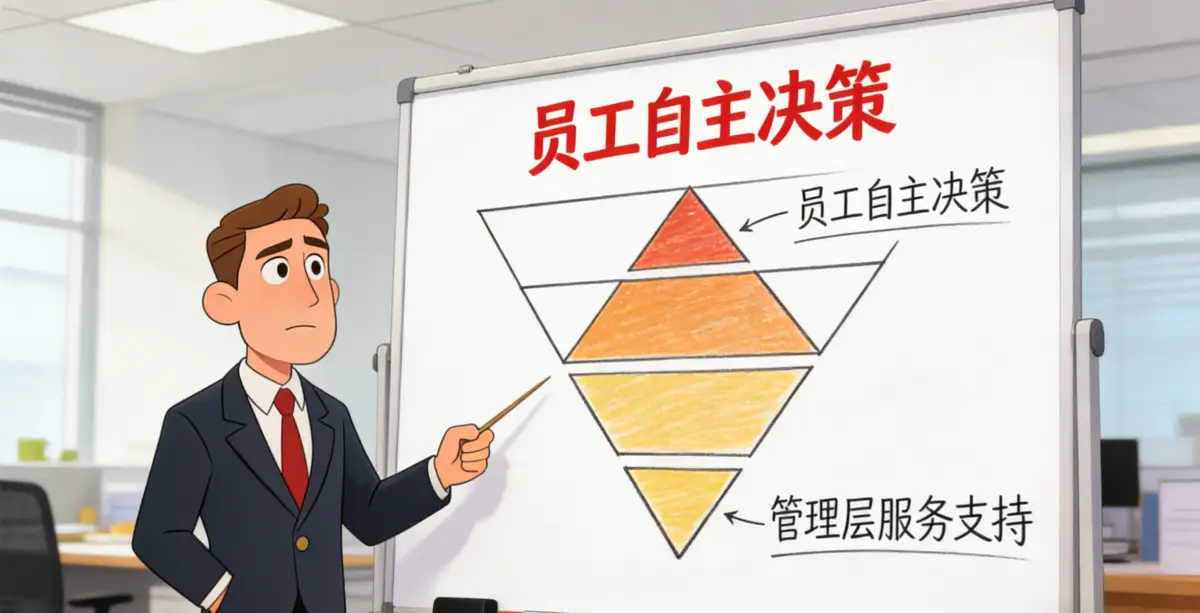
The Inverted Pyramid Management Principle(倒金字塔管理法则) is a modern management philosophy that subverts traditional bureaucratic structures. It completely inverts the traditional organizational pyramid structure (where the top is occupied by the highest decision-makers and the bottom by those who execute): front-line employees and customer-facing staff are at the very top, regarded as the most important decision-makers and innovators; middle managers play a supporting and service-oriented role; and senior leaders are at the very bottom, with their core responsibilities being to provide vision, resources, and build support systems to empower the entire organization.
Corporate Management Story Based on the Inverted Pyramid Management Principle
In early 2026, the regional distribution center of “Express Logistics” in Austin, Texas, was thrown into chaos due to a surge in demand during the peak season and severe weather. The traditional chain of command had broken down: frontline drivers were forced to take detours due to traffic restrictions but had to report the situation up the chain of command and wait for dispatch instructions; warehouse sorters discovered that the system’s recommended routes were incorrect but lacked the authority to make on-the-spot adjustments. Vice President Smith flew to the scene, only to find not a spirit of hard work, but widespread inaction and frustration.
Smith realized that traditional “pyramid” management—where decision-making resides at the top of the pyramid—had become ineffective in a rapidly changing environment. He decided to immediately pilot the Inverted Pyramid Management Principle—turning the organizational structure upside down: frontline employees would be at the top, responsible for direct decision-making and action; with managers’ core responsibilities being to provide resources and support, serving as a solid “base of the pyramid.”
The next day, he announced the launch of a 90-day “On-Site Command Authority” pilot program. First, he granted all frontline drivers and sorters “on-site decision-making authority up to $150” in emergency situations (such as temporarily renting equipment, purchasing emergency supplies, or compensating customers for minor losses), requiring only a simple post-event record in the app. Second, he transformed the dispatch center’s role from a “command center” to an “information and resource support center,” pushing real-time updates on weather, traffic conditions, and heat maps of shipment volumes, while leaving the choice of specific routes to the drivers. At the same time, he required all mid-level managers to spend one day each, over the next two weeks, riding along with a driver or working a shift—not to supervise, but to “identify and remove obstacles to frontline operations.”
In the early stages of the transformation, some managers felt a loss of authority. But by the third week, the data began to speak for itself: average delivery times were reduced by 15%, and the rate of immediate customer issue resolution soared from 35% to 90%. A veteran driver remarked, “Before, I felt like my hands were tied while driving; now, I truly have the steering wheel in my own hands.” At the wrap-up meeting, Smith said: “We turned the pyramid upside down, not to subvert the system, but to return to the essence: let those on the front lines call the shots, and our sole responsibility is to ensure they have the ammunition they need.”
What Is the Inverted Pyramid Management Principle?
The Inverted Pyramid Management Principle(倒金字塔管理法则) is a modern management philosophy that subverts traditional bureaucratic structures. It completely inverts the traditional organizational pyramid structure (where the top is occupied by the highest decision-makers and the bottom by those who execute): front-line employees and customer-facing staff are at the very top, regarded as the most important decision-makers and innovators; middle managers play a supporting and service-oriented role; and senior leaders are at the very bottom, with their core responsibilities being to provide vision, resources, and build support systems to empower the entire organization.
In organizational behavior, the Inverted Pyramid Principle represents a fundamental shift in power, responsibility, and trust. It is based on a core belief: front-line employees are the ones who best understand customers, processes, and on-the-ground issues. By granting employees substantial autonomy in decision-making, this principle aims to maximize the organization’s agility, innovation, and responsiveness to customers, while redefining managers from controllers to enablers and servants, thereby fully unleashing the organization’s potential.
I. The Origins and Theoretical Core of the Inverted Pyramid Principle
1.1 A Crisis in the Aviation Industry Sparks a Management Revolution
The Inverted Pyramid Management Principle emerged in the 1980s during a critical moment for Scandinavian Airlines. Faced with an annual loss of $20 million, then-CEO Jan Carlzon identified a fatal flaw in traditional management: frontline employees—who understood customer needs best—had no decision-making authority, and all decisions required approval through seven levels of management. Carlzon decisively inverted the management structure:
- Placing frontline employees—such as flight crews and ground staff—at the top of the pyramid
- Transforming middle managers into support roles
- Positioning the executive team as a resource-provisioning platform
Twelve months after implementation, Scandinavian Airlines achieved a profit of $54 million, and its customer satisfaction rating jumped from the bottom of the industry to the top. In his book The Moment of Truth, Carlzon articulated the core principle: “Let those who hear the gunfire command the battle.” In 1990, the Massachusetts Institute of Technology (MIT) included this case study in its classic management textbook, marking the elevation of inverted-pyramid management from corporate practice to a theoretical framework.
1.2 Scientific Validation of Modern Organizational Theory
Research on neuroleadership reveals the physiological basis of inverted pyramid management:
| Comparison of Decision-Making Quality | Frontline employees exhibit 40% lower activity in the amygdala (the emotional center) and 25% higher activity in the prefrontal cortex (rational analysis) when making decisions compared to executives |
| Response Speed Test | Problem-solving speed in an inverted pyramid structure is 3–8 times faster than in traditional hierarchical structures, particularly in dynamic and complex environments |
| Differences in Perception of Responsibility | Oxytocin secretion increases by 32% in empowered employees, promoting proactive accountability |
Research on complex systems in 2025 shows that when the pace of environmental change exceeds an organization’s decision-making speed, the survival rate of inverted pyramid structures is seven times higher than that of traditional models. At its core, this involves restructuring the organization’s information flow—shifting from a vertical process of “information reported up through layers → decisions handed down through levels” to horizontal collaboration characterized by “on-site decision-making → resource allocation.”
II. Applying the Inverted Pyramid Principle in Daily Life
2.1 Power Shift in Family Education
Modern family education is applying the inverted pyramid principle to overcome parenting challenges. Compare the following two family meeting models:
| Element | Traditional Parent-Led Model | Inverted Pyramid Child-Led Model | Effect on Behavioral Improvement |
| Agenda Setting | Parents determine the agenda | Children raise issues of concern | Participation Rate +73% |
| Problem Solving | Parents propose solutions | Children lead the discussion of solutions | Implementation Rate +156% |
| Division of Responsibilities | Parents assign tasks | Family members voluntarily take on tasks through negotiation | Task sustainability +89% |
Developmental psychologists have found that in families adopting the inverted pyramid model, children’s self-directed planning skills score 42% higher than in traditional families, and family conflicts are reduced by 68%. The key lies in the parents’ role transition—from commanders to “scaffolding” providers, offering support rather than directives when children need it.
2.2 Co-governance Experiment in Community Management
Community governance is a natural setting for applying the inverted pyramid model. A community of 10,000 residents implemented a “three-tier reversal”:
| Decision-Making Reversal | 70% of the annual budget allocation authority was handed over to building representatives → resulting in 17 innovative public projects |
| Execution Reversal | Property management staff transitioned to technical support roles → residents spontaneously formed greening, security, and activity groups |
| Evaluation Inversion | The Residents’ Committee evaluates the property management company, rather than the other way around → Service response times improved threefold |
Two years after implementation, the community’s property fee collection rate rose from 65% to 98%, and it was honored as a “National Model Community for Self-Governance.” A 2025 report by the Ministry of Civil Affairs noted that communities adopting inverted pyramid governance have a resident happiness index 2.3 standard deviations higher than that of traditional communities.
2.3 The Classroom Revolution in Educational Reform
Innovative schools are reshaping education through the inverted pyramid model:
- Elementary school classrooms implement a “student research office” system → Teachers design curricula based on student proposals
- Middle school students independently schedule 40% of their study time → Project-based learning outcomes increase threefold
- University laboratories are led by graduate students in determining research directions → The number of innovation patents increases by 170%
Research in educational neuroscience has found that when students are given the authority to design their own instruction, synergistic activity in the prefrontal cortex and hippocampus increases by 55%, and knowledge retention improves by 40%. The 2025 Global Education Innovation Index shows that schools using the inverted pyramid teaching model score highest in fostering creativity.

III. The Inverted Pyramid Principle and Inverted Pyramid Transformation in the Workplace
3.1 Reversing the Center of Gravity in Organizational Structure
Pioneering companies are restructuring their organizational frameworks to achieve a leap in efficiency:
1)Manufacturing Case Study
A factory delegated decision-making authority on production lines to teams of workers:
Equipment procurement was decided by a vote among the workers who would use the equipment
Proposals for production process improvements go directly to implementation
Team leaders transition to the role of coordinators
Result: Defect rate decreased by 79%, energy consumption reduced by 42%
2)Technology Company Case Study
An IT company implemented a “project autonomy system”:
Engineers form teams independently to bid on projects
HR and finance departments transition to service platforms
Senior executives retain only strategic veto power
Result: Time-to-market doubled, and turnover rate dropped to one-third of the industry average
Organizational behavior data shows that inverted pyramid organizations achieve 3.8 times higher per-capita efficiency than traditional structures, with particularly significant advantages in new business development.
3.2 Neural Reconstruction of Decision-Making Mechanisms
Inverted pyramid enterprises establish a unique decision-making nervous system:
| Decision Type | Traditional Model | Inverted Pyramid Model | Time Comparison |
| Resolving Customer Issues | Report to supervisor → Departmental co-signature → Executive approval | Frontline staff make direct decisions (within budget) | From 3 days → 20 minutes |
| Product Improvements | Market research → Feasibility report → Project approval | R&D team independently initiates rapid iteration | From 6 months → 2 weeks |
| Crisis Management | Emergency response team → Tiered reporting → Solution | On-site team directly activates contingency plan | From 8 hours → Immediate response |
The 2025 Global Agile Organizations Report shows that the error rate in inverted pyramid decision-making systems is 65% lower than in the traditional model, because decision-makers and executors are the same individuals, thereby avoiding information distortion.
3.3 Redefining the Essence of Leadership
The inverted pyramid model reshapes the essence of leadership:
| Resource Integrator | When a project team needs specialized equipment, the traditional approval process takes 3 weeks; under an inverted pyramid leader, it is coordinated and secured within 2 hours. |
| Barrier Remover | By eliminating barriers to departmental collaboration, the delivery cycle for cross-functional projects is shortened by 70%. |
| Meaning Creator | By translating the organizational vision into mission narratives for each team, employees’ sense of purpose increases threefold. |
LinkedIn’s 2025 Leadership Survey reveals that in inverted pyramid organizations, leaders spend 70% of their time on service and support, and only 30% on decision-making and control; this ratio correlates positively with organizational effectiveness (r=0.91).
3.4 Comparative Analysis of Related Management Models
To understand the inverted pyramid principle, it is necessary to distinguish it from similar management paradigms:
| Management Model | Power Structure | Differences from the Inverted Pyramid | Applicable Scenarios |
| Inverted Pyramid Management | Frontline staff at the top | Systematic reversal of power | Complex and dynamic environments |
| Flat Management | Reduced hierarchy | Still maintains top-down decision-making | Small and medium-sized enterprises |
| Holacracy | Role autonomy | No hierarchy but no clear apex | Creative organizations |
| Agile Management | Iterative optimization | Methodology rather than power restructuring | Project teams |
| Servant Leadership | Leaders serve | Individual behavior rather than systemic design | Value-driven organizations |
The uniqueness of the inverted pyramid model lies in its “structure-first” approach—enforcing the transfer of power through institutional design. In manufacturing transformation, companies adopting the inverted pyramid model have new product development cycles that are 60% shorter than those of companies using flat management, because moving the decision-making chain to the front end eliminates barriers to innovation.
IV. Methods for Applying the Inverted Pyramid Management Principle in Organizational Behavior
4.1 Redefining the Boundaries of Authority and Decision-Making
Method: Clearly and formally grant front-line employees autonomous decision-making authority in specific areas (such as customer service, minor expenditures, and process fine-tuning). Establish clear decision-making frameworks (such as “Service Recovery Guidelines” or “Innovation Experiment Budgets”), within which no approval is required. Significantly reduce the list of items requiring management approval, retaining only those that are truly strategic or high-risk.
Example: By granting front-line employees “$150 on-site decision-making authority” and streamlining the reporting process, Smith substantially shifted decision-making power toward the base of the pyramid.
4.2 Transforming the Manager’s Role: From “Commander” to “Empowering Coach”
Method: Retrain and evaluate managers. Their core performance metrics should shift from “whether the team follows orders” to “whether they have cleared obstacles for the team,” “whether they have provided sufficient resources and tools,” and “whether the team’s ability to solve problems independently has improved.” Hold regular “support needs” meetings to allow employees to raise issues requiring assistance with their managers.
Example: Requiring mid-level managers to shadow frontline staff to “identify and remove obstacles” and transforming the dispatch center into an “information and resource support center” are both fundamental shifts in the manager’s role.
4.3 Establishing Transparent Information Flows and Feedback Loops
Method: Ensure that all key business information (such as performance data, customer feedback, and strategic direction) is transparent and accessible to all employees. Establish rapid feedback channels from the front lines directly to senior leadership (such as regular “Voice of the Front Line” meetings or anonymous suggestion platforms) to ensure senior leadership can hear the “sound of gunfire” firsthand and adjust support strategies accordingly.
Example: Utilize apps and real-time data dashboards to enable drivers and sorters to directly access the information needed for decision-making, while their decision data and records are instantly fed back into the support system.

V. Application of the Inverted Pyramid Management Principle in Human Resources Management
5.1 Recruitment and Selection: Seeking “Self-Motivated Decision-Makers”
Method: During recruitment, focus on assessing candidates’ initiative, problem-solving abilities, and willingness to take responsibility. Use scenario-based simulations to evaluate their potential to make sound, independent judgments under conditions of incomplete information or time pressure. Select individuals who are both eager and capable of exercising autonomy.
Example: Ask during the interview: “If you encounter a customer complaint not covered in the manual and your supervisor is temporarily unavailable, what steps would you take to handle it?”
5.2 Training System: From “Skills Training” to “Decision-Making Capacity Development”
Method: Shift the training focus from purely operational skills to the development of “decision-making competencies,” such as business acumen, data analysis, risk assessment, and creative problem-solving. Provide employees with training on the company’s cost structure, profit model, and strategic objectives, enabling them to make decisions that benefit the company as a whole within their delegated authority.
Example: Offer a “Mini-MBA” course for newly promoted front-line managers, covering basic finance, operational analysis, and customer psychology, to help them understand the broader implications of their decisions.
5.3 Performance and Incentives: Recognizing and Rewarding “Responsible Autonomous Action”
Method: In performance evaluations, significantly increase the weight given to behaviors such as “initiative,” “innovative attempts,” and “independent resolution of customer issues.” Establish special bonuses or immediate recognition programs to reward individuals and teams who use their autonomy to create significant value for the company or prevent major losses. Even if an attempt fails, it should be encouraged as long as the process was reasonable and provided valuable lessons.
Example: Establish a “Best On-Site Decision Award” to recognize, on a quarterly basis, the best examples of individuals who have used their autonomy to save the company costs, improve customer satisfaction, or optimize processes.
5.4 Career Development and Cultural Shaping: Creating “Expert-Track” Growth Paths
Method: Establish robust professional/expert promotion pathways so that employees who are not suited for or do not prefer traditional management roles—but who excel in frontline decision-making and specialized fields—can attain status, compensation, and influence equivalent to those in management positions. Culturally, continuously promote the values of “taking initiative and accountability” and “leadership is service.”
Example: Create expert titles such as “Chief Customer Officer” and “Senior Technical Fellow,” with compensation packages and decision-making authority in major company decisions that are no less than those of director-level positions.
The essence of the Inverted Pyramid Management Principle lies in the reversal of organizational power dynamics, shifting the focus of decision-making from the top down to the front lines. Originating during a time of crisis at Scandinavian Airlines, it has been validated by over three decades of practice and has become a revolutionary paradigm for navigating complex environments. In daily life, it reshapes family education models, unleashes the potential for community self-governance, and transforms the relationship between educators and students; in the workplace, it restructures organizational frameworks, reengineers decision-making systems, and redefines the essence of leadership.
Compared to models such as flat hierarchies and holacracy, the breakthrough of the Inverted Pyramid Management Principle lies in its structural transformation—it not only reduces hierarchical levels but also completely reverses the flow of power. The 2025 Global Organizational Effectiveness Report shows that companies adopting the inverted pyramid model lead across the board in metrics such as customer response speed (3–8 times faster), employee initiative (2.5 times higher), and innovation capacity (4.7 times stronger). The key to implementation lies in three transformations: establishing frontline empowerment mechanisms at the institutional level, embedding autonomous decision-making nodes into processes, and fostering a spirit of accountability at the cultural level. When organizations dare to turn the pyramid upside down, they unleash not only increased efficiency but also an evolutionary leap in human collaborative wisdom.

VI. Evolution and Summary of the Inverted Pyramid Management Principle
6.1 Evolution of the Inverted Pyramid Management Principle
Intellectual Pioneers and Early Practices (Mid-to-Late 20th Century)
Its philosophical roots can be traced back to Douglas McGregor’s “Theory Y” (which assumes that employees are self-motivated and willing to take responsibility). In practice, some innovative U.S. companies (such as Gore) and democratic management practices in Northern Europe provided early models.
The Classic Case of Jan Carlsson and Scandinavian Airlines (1980s)
This principle gained global recognition through the successful implementation by Jan Carlsson, former CEO of Scandinavian Airlines (SAS). In the 1980s, to reverse the company’s decline, Carlsson explicitly proposed and institutionalized the inverted pyramid model. He placed employees who directly served customers at the top, requiring managers to report to them and provide support, thereby rapidly transforming SAS from a loss-making company into a benchmark for high profitability and quality service.
Integration with “Empowerment Leadership” and “Decentralized Organization” Theories (21st Century)
Contemporary leadership theories, such as empowering leadership, emphasize that leaders unlock the potential of their subordinates by sharing power, providing support, and creating an environment of autonomy—a philosophy that aligns closely with the inverted pyramid concept. At the same time, with the rise of decentralized organizational models such as “Holacracy,” “agile organizations,” and “networked organizations,” the inverted pyramid principle has evolved from a management philosophy into a set of actionable organizational structures and operational processes.
Comprehensive Empowerment Platforms in the Digital Age
In the digital age, the practice of the Inverted Pyramid Management Principle has been bolstered by technology. Through cloud platforms, big data analytics, and mobile tools, frontline employees have access to unprecedented levels of information and resources, enabling them to make more informed decisions. Managers, in turn, can use data dashboards to gain an overview of the overall situation, allowing them to focus on strategic empowerment and system optimization, thereby making the operation of the inverted pyramid more efficient and measurable.
6.2 Comparison and Contrast
| Dimensions of Comparison | McGregor’s Theory Y (Assumptions About Human Nature) | Jan Carlsson’s Approach (Business Transformation) | Empowerment Leadership (Leadership Behavior) | Decentralized Organization (System Structure) |
| Essence | A fundamental management assumption that human nature is inherently good and that employees possess an innate sense of responsibility and creativity. | A renowned business case in which, based on specific assumptions about human nature, organizational structures and power dynamics were systematically inverted within a real-world company, resulting in tremendous success. | A leadership theory that specifically describes how leaders should transform their mindset, communication style, and behavioral priorities under the inverted pyramid model. | A general term for a new type of structured organizational model in which decision-making authority and control over resources are widely distributed across organizational nodes (rather than at the top). |
| Core Focus | “What are employees fundamentally like?” (philosophical premise). | “How can this belief be transformed into a profitable business model?” (practical validation). | “What exactly should leaders do—and not do—in such an organization?” (role guidelines). | “What are the institutional frameworks and technological tools that support this model?” (operating system). |
| Key Contributions | Provides the most fundamental theoretical justification for the inverted pyramid: if one believes in Theory Y, then decentralization is an inevitable choice. | Through sensational business success, it proves that the inverted pyramid is not a utopian theory but a practical and viable competitive tool, offering a blueprint worth emulating. | It provides traditional managers with a “user manual” for transformation and psychological preparation, alleviating the anxiety of “What will I do after power is delegated?” | It provides the organizational “structural framework” and technical infrastructure needed to institutionalize, scale, and sustain the inverted pyramid concept. |
| Relationship with the Inverted Pyramid Principle | It is its “philosophical cornerstone” and “spiritual core.” | It is its “epic promotional video” and “showcase of success.” | It is its “director’s code of conduct” and “guide for lead actors.” | It is its “theater architectural blueprint” and “intelligent stage control system.” |
6.3 Core Connections
Together, these four elements form a complete chain of innovation and implementation: “Conceptual Foundation → Practical Validation → Role Definition → System Consolidation”:
Conceptual Foundation (Theory Y): McGregor’s Theory Y is the intellectual source of all subsequent developments. It challenges traditional Theory X (which posits that human nature is inherently lazy and requires strict control) by proposing a revolutionary hypothesis: employees are self-motivated, willing to take responsibility, and creative. This provides the fundamental humanistic basis for “placing employees at the top and empowering them.” Without this belief, the inverted pyramid would be a tree without roots.
Practical Validation (Carlsson’s Practice): Jan Carlsson was like a courageous architect who, armed with the blueprints of Theory Y, built a magnificent inverted pyramid edifice in the real business world—on the grounds of Scandinavian Airlines—and achieved tremendous success. With ironclad business results, he proved to the world that this concept was not a pipe dream, but a powerful model capable of generating profits and competitiveness. This greatly accelerated the spread and acceptance of the concept.
Role Definition (Empowerment Leadership): When an organization undergoes a structural flip, the managers who struggle the most are often the former managers. The theory of empowering leadership emerged in response to this need, detailing the new roles, skills, and mindsets required of leaders under the new structure—how to transition from a commander to a coach, a servant, and a system designer. This addressed the most critical issue of “human transformation” during the implementation of the concept, ensuring that the organization could operate smoothly and effectively after the structural flip.
Systemic Institutionalization (Decentralized Organizations): To ensure that the inverted pyramid model does not rely on a single visionary leader (such as Carlsson) and can be adopted at scale and institutionalized by more organizations, the decentralized organizational model (such as Holacracy) provides a pre-designed, detailed “socio-technical system.” It includes clear rules for the allocation of decision-making authority, meeting procedures, role-definition tools, and digital collaboration platforms. This marks the evolution of the inverted pyramid from an art of exceptional leadership into a replicable, iterable, and standardized “organizational operating system.”
In short, this is a process where “a thinker proposes a bold hypothesis (Theory Y) → an entrepreneur validates this hypothesis through a company (Carlsson) → a group of management scholars writes a transformation handbook for other managers based on this (Empowered Leadership) → and finally, organizational designers develop ‘software packages’ and ‘hardware’ that allow this new model to be deployed at scale (decentralized organizations).”
6.4 Summary: A Metaphor
McGregor’s Theory Y: It is like Copernicus proposing the “heliocentric theory”—which overturned the traditional notion that “the Earth (managers) is the center of the universe” and posited that “the Sun (employees) is the center.” This was a fundamental revolution in worldview.
Jan Carlsson’s Practice: This is akin to Magellan’s fleet completing a circumnavigation of the globe—proving through practice that the new route guided by the “heliocentric model” was viable and could bring back spices and gold. This was an epic expedition that validated the new theory.
Empowering Leadership: This is akin to The Captain’s Guide to Circumnavigation, written for all future captains—detailing how, under the heliocentric worldview, a captain can no longer command the Sun but must instead learn to read the stars (data), maintain the ship’s hull (systems), and inspire the sailors’ (employees’) passion for exploration. It serves as a practical handbook for those undergoing transformation.
Decentralized Organizations: This is akin to inventing a “Satellite-Based Automatic Navigation System Combined with a Crew Autonomy Charter for Democratic Decision-Making”—even without a genius captain like Magellan, any ship equipped with this system can enable sailors to make autonomous decisions based on real-time data and clear rules, thereby efficiently completing a circumnavigation. This transforms genius-driven practices into widely applicable technologies and institutional frameworks.
References
- Carlzon, J. (1987). Moments of Truth. Harper Business.
- Laloux, F. (2014). Reinventing Organizations. Nelson Parker.
- China Society of Management Science. (2025). “The Practice of Inverted Pyramid Management in Chinese Enterprises.” Journal of Management.
- MIT Organizational Design Lab. (2025). Neural Basis of Decentralized Decision Making. Science.
- Harvard Power Structure Research Center. (2025). “The Inverted Pyramid in Crisis Management.” Harvard Business Review.
- Jan Carlzon – Moments of Truth (MOT) and other writings on the reform of Scandinavian Airlines.
- Douglas McGregor – “X-Y Theory.”
- Literature on “Empowerment Leadership” (e.g., Kenneth Blanchard’s work) and “Servant Leadership” (Robert K. Greenleaf).
- Contemporary organizational design research on “Holacracy,” “Agile Organizations,” and “Platform Organizations.”
- Comparison and correlation of relevant concepts in the historical evolution of the Inverted Pyramid Management Principle.