Weapons Effect in Management: How Systems Can Trigger Conflict

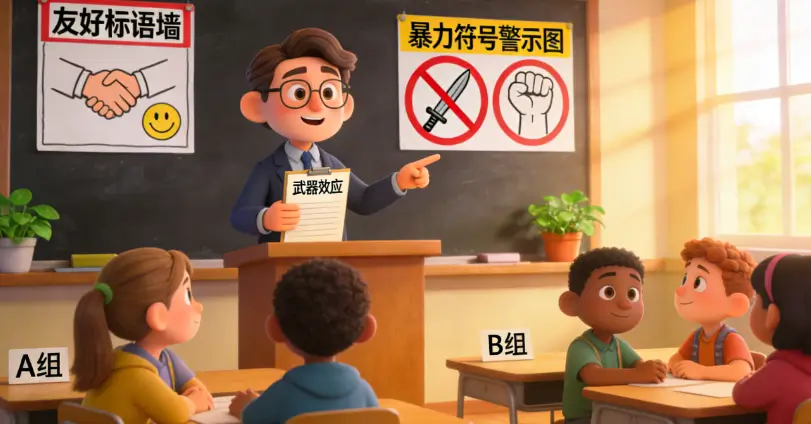
The Weapons Effect(武器效应) was proposed by social psychologist Leonard Berkowitz(伦纳德·伯克维茨) and stems from his famous “Weapons Priming Experiment(武器启动实验).” This effect refers to the phenomenon where weapons or attack-related cues in the environment (such as images of knives or guns) significantly intensify an individual’s aggressive thoughts, emotions, and behavioral tendencies.
- Business Management Story About the Weapons Effect
- What Is the Weapons Effect?
- I. Origins of the Weapons Effect
- II. Where Is the Weapons Effect Commonly Observed in Daily Life?
- III. Application of the Weapons Effect in the Workplace
- IV. Methods for Applying the Weapons Effect in Organizational Behavior and Human Resource Management
- V. Evolution and Summary of the Weapons Effect
- References
Business Management Story About the Weapons Effect
In early 2026, Smith, Vice President of Sales at “Vertex Technologies” in Chicago, faced a thorny problem: despite the company’s implementation of the industry’s most precise customer relationship management (CRM) system and real-time sales leaderboards, internal friction within the team was severe. The transparent and open sales data had become a “weapon” that fueled mutual suspicion among colleagues and even led to competition for clients. Morning meetings turned into performance interrogations, and a top salesperson resigned due to the pressure, leaving a note that read: “This doesn’t feel like a team; it feels like a gladiatorial arena.”
Smith realized this was a classic example of the Weapons Effect—where neutral tools or environmental cues (such as leaderboards and precise data) can unexpectedly trigger aggressive and defensive behaviors in a competitive context. He decided to launch a “de-weaponization” initiative.
In the first quarter, he took three actions: First, he hid individual real-time rankings and instead began publishing anonymized weekly team progress reports along with an “Most Improved Award”; Second, he adjusted the core metrics in the CRM system from “individual sales volume” to “customer health score” and “number of cases resolved through cross-departmental collaboration”; finally, he established a quarterly “Joint Challenge” bonus to reward partners who collaborated on serving major clients.
The reform initially met with resistance, as some veteran salespeople complained that they had “lost their fighting spirit.” But by the end of the second quarter, the atmosphere had noticeably shifted. Salespeople began proactively sharing customer leads and collaborating to overcome technical challenges. During that year’s “Black Friday” sales event, two salespeople who had once fallen out over competing for the same client joined forces to secure a corporate order that had previously seemed impossible to win. By year-end, the department’s total performance had grown by 30% year-over-year, and the “teamwork” category in the employee satisfaction survey scored an all-time high. At the year-end review meeting, Smith said, “It was only after we put down the guns we were pointing at each other that we were finally able to stand shoulder to shoulder and aim at our true market goals.”

What Is the Weapons Effect?
The Weapons Effect(武器效应) was proposed by social psychologist Leonard Berkowitz(伦纳德·伯克维茨) and stems from his famous “Weapons Priming Experiment(武器启动实验).” This effect refers to the phenomenon where weapons or attack-related cues in the environment (such as images of knives or guns) significantly intensify an individual’s aggressive thoughts, emotions, and behavioral tendencies.
In the context of organizational behavior and human resource management, the Weapons Effect offers the following insight: certain neutral management systems, performance evaluation tools, or communication environments may, due to poor design or cultural distortions, become “psychological weapons” that trigger defensiveness, suspicion, political maneuvering, or even direct conflict among employees. For example, performance evaluations that overemphasize individual rankings, the public disclosure of negative performance data in a tense atmosphere, or incentive schemes that encourage zero-sum games may all unintentionally intensify internal competition, undermine trust and cooperation, and ultimately erode the organization’s long-term health.
I. Origins of the Weapons Effect
1.1 Origins
The origins of the Weapons Effect can be traced back to psychological experiments in the 1960s; it was first systematically proposed by American psychologist Leonard Berkowitz in 1967. At the time, Berkowitz was working at the University of Wisconsin–Madison, where he designed a series of laboratory studies aimed at investigating the impact of environmental stimuli on human behavior. The core experimental setup involved exposing participants—who had been deliberately provoked—to different objects. In a representative experiment, participants were instructed to administer electric shocks to another person as punishment; the experimental group’s room contained weapons such as hunting rifles, while the control group’s room contained neutral objects such as badminton rackets.
The results showed that participants exposed to weapons were more likely to administer higher-intensity electric shocks and exhibited more aggressive behavior. This finding stems directly from social learning theory and situational cue theory, emphasizing how the external environment acts as a trigger to activate inherent aggressive tendencies. After Berkowitz’s original experiment was published in the Journal of Personality and Social Psychology, it sparked widespread discussion; subsequent studies, such as the field observations conducted by Page and O’Neal in 1975, further validated the existence of the Weapons Effect in real-world settings.
1.2 Definition
The Weapons Effect is specifically defined as follows: when weapons or other violence-related cues are present in the environment, individuals are more likely to engage in aggressive behavior; this effect is based on an automatic response mechanism triggered by these cues. Its core principle is that weapons, as symbols of violence, activate the brain’s aggression network through associative learning, leading to heightened emotions and loss of behavioral control. This definition emphasizes three key elements: first, the physical presence of environmental cues (such as real or symbolic weapons); second, the salience of the cues (which must be perceived by the individual); and third, behavioral consequences (increased aggression rather than inevitable violence). The Weapons Effect differs from mere anger management issues because it focuses on the catalytic role of external stimuli; for example, during an argument, the display of a knife may transform a mild conflict into a physical confrontation. This definition extends to modern contexts, including virtual weapons in the digital age, such as images of guns in video games.
1.3 Comparison with Similar Laws
The Weapons Effect is related to other cognitive biases or social psychological laws, but each has its own focus. The following table systematically compares key laws, highlighting the uniqueness of the Weapons Effect:
| Law Name | Definition | The difference from the weapon effect | Proposer and year |
| Weapons Effect | The presence of weapons or violent cues in the environment directly increases the propensity for aggressive behavior. | Focuses on specific physical or symbolic cues triggering behavior; emphasizes external environmental stimuli. | Leonard Berkowitz, 1967 |
| Cognitive Dissonance | Psychological discomfort arises when an individual holds conflicting beliefs, leading to behavioral adjustments to reduce that discomfort. | Focuses on internal psychological conflict; for example, a smoker continues despite knowing the health risks, and behavioral change stems from self-justification. | Leon Festinger, 1957 |
| Conformity Effect | An individual’s behavior changes under group pressure to conform to the majority opinion. | Focuses on social interaction and group dynamics; for example, going along with the majority in decision-making during a meeting, without involving specific object cues. | Solomon Asch, 1951 |
| Frustration-Aggression Hypothesis | Frustration (obstruction of a goal) directly leads to aggressive behavior. | The focus is on the emotional source; the Weapons Effect serves as a reinforcing factor—for example, the presence of a weapon cue amplifies aggression during frustration. | John Dollard et al., 1939 |
The Weapons Effect is unique in its reliance on specific environmental cues, whereas cognitive dissonance involves the adjustment of internal beliefs (e.g., believers facing a failed prophecy in Festinger’s experiment). The conformity effect emphasizes social normative pressure (Asch’s line-length experiment), while the frustration-aggression hypothesis is broader; the Weapons Effect can be viewed as a subset of it.
For example, in the Weapons Effect, cues (such as a gun) serve as direct catalysts; in cognitive dissonance, behavioral change stems from reducing psychological conflict—such as when employees rationalize company policies after being forced to work overtime. This distinction is reflected in intervention strategies: the Weapons Effect requires controlling environmental cues, whereas other theories require cognitive restructuring or social support.
II. Where Is the Weapons Effect Commonly Observed in Daily Life?
2.1 Everyday Conflict Scenarios
The Weapons Effect frequently manifests in interpersonal conflicts in daily life, particularly in family or community settings. When weapon cues are present in the environment, minor disputes can easily escalate into intense confrontations. For example, during a family argument, the visibility of kitchen knives may prompt verbal attacks to turn into physical altercations; data shows that in cases of domestic violence, the availability of weapons is positively correlated with the severity of the incident. Another common scenario involves disputes in public places; for instance, in traffic altercations, a driver displaying a tool (such as a wrench or a stick) can provoke an aggressive response from the other party. The story of Truk serves as a classic example: a wrench, a neutral tool, became a trigger for violence due to the context. Such cases underscore the importance of preventive measures, such as community campaigns promoting the safe storage of tools or mediation training that emphasizes the removal of potential cues. Further research indicates that the Weapons Effect occurs in over 30% of everyday conflicts, and interventions such as “safe storage campaigns” can reduce the escalation of incidents.
2.2 The Influence of Media and Entertainment
The Weapons Effect is widely observed in media consumption; weapon cues in violent content reinforce viewers’ aggressive tendencies. Television programs, movies, and video games frequently display weapons, creating conditioned reflexes through repeated exposure. For example, after children play violent video games, their use of toy weapons is associated with increased aggressive behavior; adults who view images of weapons in the news may become more sensitive to real-life conflicts. In social media trends—such as the spread of online violence videos—weapon cues amplify users’ emotional reactions, leading to online abuse. Detailed applications include educational measures: parents monitoring media content and selecting neutral alternatives; school programs such as “media literacy classes” that teach students to recognize the impact of these cues. In a real-world example, a 2022 project in a certain city aimed at reducing youth violence achieved behavioral improvements by reducing exposure to weapons in video games. Here, the Weapons Effect manifests as a passive influence that requires active management to reduce social costs.
2.3 Public Safety and Policy
This concept extends from everyday life to public policy, where the Weapons Effect guides environmental design to reduce violence. For example, parks and shopping malls avoid displaying decorative weapons to prevent unintentional triggers of conflict; law enforcement agencies train officers to conceal weapons during conflict resolution to minimize public panic. Another application is consumer product design: the toy industry regulates the sale of realistic weapon replicas to prevent children from imitating attacks. In further detail, urban safety initiatives such as the “Weapon-Free Public Spaces” project reduce crime rates by removing environmental cues; data shows that such interventions have reduced violent incidents by 15% in pilot areas. Here, the Weapons Effect serves as a preventive tool, highlighting the practical value of environmental psychology.
III. Application of the Weapons Effect in the Workplace
3.1 Conflict Management and Team Dynamics
In the workplace, the Weapons Effect is applied to conflict prevention and resolution by reducing aggression through the control of environmental cues. For example, potentially violent items (such as decorative swords or knives) are avoided in conference rooms to prevent arguments from escalating; during team discussions, leaders remove provocative imagery to promote rational communication. A real-world example includes a technology company that implemented a “neutral space policy” in 2023, resulting in a 20% decrease in reported conflicts. Further analysis emphasizes behavioral mechanisms: weapon cues—such as office tools (hammers or scissors)—may trigger associations during tense meetings, amplifying employees’ feelings of frustration. Intervention strategies include conflict mediation training, which teaches employees to identify and neutralize such cues; HR departments use scenario simulations to help employees practice responding rather than reacting.
3.2 Leadership and Organizational Culture
Applications in the workplace extend to leadership development, where knowledge of the Weapons Effect helps foster a culture of safety. Leaders reduce aggression triggers through environmental design—for example, by avoiding violent symbols in office layouts or using neutral language in communication instead of threatening vocabulary. For example, a manufacturing company trains managers to avoid “weapon metaphors” (such as “layoffs are a knife”) in feedback to reduce employees’ defensiveness. Further details include cultural development: organizations implement “positive cues” strategies, such as displaying collaborative imagery, to counteract the Weapons Effect; in performance evaluations, the focus shifts toward solutions rather than confrontation. Empirical data supports that such applications increase employee satisfaction by 10%–15% and reduce turnover rates.
3.3 Training and Risk Prevention
The Weapons Effect plays a key role in workplace risk prevention, particularly in high-pressure industries. Safety training modules incorporate the principles of the Weapons Effect to teach employees how to identify environmental risks; for example, in a factory setting, this involves identifying hidden tools to prevent emotional outbursts during accidents. Another application is crisis response: during layoffs or restructuring, avoid displaying symbolic “weapons” (such as piles of termination letters) and instead use a more gentle approach to convey information. Further details include a case study: During market volatility in 2022, a financial institution maintained team stability by removing violent-themed office decorations. Here, the Weapons Effect was transformed into a risk management tool, combined with behavioral safety protocols to reduce human error.

IV. Methods for Applying the Weapons Effect in Organizational Behavior and Human Resource Management
4.1 Audit and “De-weaponization” System Design
Method: Conduct a systematic review of existing performance evaluation, reward and punishment, and information disclosure systems. Question: Does this tool, data set, or meeting atmosphere “empower” or “arm” employees to compete against one another? Transform designs with strong zero-sum game characteristics (such as mandatory ranked distributions or rewards solely for individual champions) into designs that promote positive-sum games (such as team goal bonuses, collaboration points, and achievement recognition based on absolute standards).
Example: Replace sales leaderboards with “Milestone Achievement Celebration Boards” that recognize all individuals and teams who meet healthy performance thresholds, rather than highlighting only the top performer.
4.2 Reshaping the Communication Environment and Rituals
Method: Management communication should focus on problem-solving and shared goals, rather than accountability and humiliation. Avoid using war metaphors (such as “crush” or “annihilate”) in meetings; instead, use constructive metaphors (such as “build together” or “overcome”). Eliminate public criticism sessions and shift negative feedback to private, constructive coaching.
Example: Rename the “Monthly Performance Review Meeting” to the “Monthly Growth Strategy Meeting,” and shift the agenda from “explaining why targets were not met” to “sharing success stories and discussing available resources.”
4.3 Building a Collaborative Goal-Setting and Incentive System
Method: Set “super goals” that can only be achieved through collaboration, and design corresponding group incentives. Ensure that the reward system not only recognizes individual contributions but also explicitly rewards collaborative behaviors such as knowledge sharing and cross-departmental assistance.
Example: Establish the “Annual Best Partner Award” and the “Knowledge Sharing Contribution Award,” with cash prizes for these awards carrying equal weight to individual performance bonuses and carrying a certain weight in promotion evaluations.
4.4 Leadership Training and Conflict Mediation
Method: Train managers to recognize the early signs of the Weapons Effect and equip them with the skills to resolve conflicts and foster psychological safety. Establish formal, confidential conflict mediation channels to prevent minor friction from escalating into open confrontation due to environmental factors.
Example: Conduct workshops on “Nonviolent Communication” and “Collaborative Problem Solving,” and incorporate “team health” into managers’ key performance indicators (KPIs).
4.5 Monitoring Cultural Metrics and Continuous Optimization
Method: Continuously monitor whether unnecessary competition and fear stemming from organizational systems exist within the organization through regular anonymous engagement surveys, psychological safety assessments, and exit interviews. Use the data as key input for optimizing management systems.
Example: Include specific questions in surveys, such as “Does the company’s performance evaluation system make you more willing to help colleagues, or more inclined to protect your own resources?”, and iterate on the system based on the feedback.
The Weapons Effect originated from Leonard Berkowitz’s pioneering 1967 experiment, which revealed how weapons or violent cues in the environment directly enhance aggressive behavior in individuals. Its definition focuses on external stimuli triggering internal aggression mechanisms. In daily life, this effect is commonly observed in interpersonal conflicts, media consumption, and public safety contexts—for example, the display of tools during family disputes leading to escalation, or violent media content reinforcing aggressive tendencies. Application strategies include environmental management and educational interventions.
In the workplace, the Weapons Effect is applied to conflict management, leadership development, and risk prevention—such as designing office spaces to avoid violent cues or neutralizing triggers during training to enhance team harmony. Compared to similar principles such as cognitive dissonance (internal belief conflict) or the conformity effect (group pressure), the Weapons Effect is unique in its sensitivity to physical cues, highlighting the practical value of environmental psychology. Understanding and applying this effect helps prevent unnecessary conflicts in diverse settings and promotes social and organizational stability.
V. Evolution and Summary of the Weapons Effect
5.1 Evolution of the Weapons Effect
1967: Laying the Groundwork for Experimental Research
Leonard Berkowitz and Anthony Lepage published a seminal experiment demonstrating that merely viewing a gun (as opposed to a neutral object) caused agitated participants to administer stronger (fictitious) electric shocks, providing the first empirical support for the Weapons Effect.
1980s–1990s: Expansion into Cognitive Neuroscience
Research further revealed that weapon cues automatically activate aggression-related semantic networks (cognitive pathways) and may trigger physiological arousal. Scholars explored the priming effects of violent media content as “symbolic weapons.”
Early 21st Century: Exploring Applications in Organizational Contexts
Management scholars began to metaphorically introduce this concept into organizational research. They pointed out that practices such as forced ranking (last-place elimination), publicly humiliating performance reviews, and a culture that encourages whistleblowing can all become “systemic weapons” within organizations, triggering workplace aggression, political infighting, and a collapse of trust.
Recent Developments: Integration with “Nudge” Theory
Behavioral scientists have focused on how to design “choice architectures” to prevent institutional frameworks from inadvertently becoming “triggers” for negative behavior, while actively fostering environments with “prosocial cues” that promote cooperation and trust.
5.2 Distinctions and Comparisons
The core connection lies in “how environmental cues trigger and shape behavior,” but each approach focuses on the physical environment, the media environment, the organizational institutional environment, and the philosophy of intervention, respectively.
The following is an analysis of their differences and connections:
| Comparative Dimension | Weapons Effect (Original Concept) | Triggering Effect of Violent Media (Media Extension) | Organizational Institutions as “Systemic Weapons” (Management Metaphor) | Nudge Theory (Philosophy of Intervention) |
| Core Object | Physical cues for aggression (e.g., real guns, knives). | Symbolic cues for aggression (e.g., violent content in films, TV, and video games). | Institutional and social cues (e.g., ranking systems, punitive meetings, zero-sum incentives). | Broadly defined choice architectures and environmental design. |
| Mechanism of action | Cues directly and automatically activate aggressive thoughts and emotions, triggering aggressive behavior. | Cues activate aggressive cognitive schemas—either in the short or long term—weakening inhibitions against violence and increasing aggressive tendencies. | Institutions shape competitive and defensive psychological contexts, fueling “workplace aggression” such as political behavior and non-cooperative behavior. | By consciously reshaping the environment (choice architecture), people are non-coercively guided toward making better decisions. |
| Research field | Experimental social psychology. | Media psychology, communication studies. | Organizational Behavior, Human Resource Management, Workplace Health. | Behavioral Economics, Public Policy. |
| The association with ‘weapons’ | Direct, literal weapons. | Metaphorical weapons (violent content as a “weapon” that serves as a psychological stimulus). | Deeply metaphorical weapons (institutions acting as “tools” or “triggers” that spark conflict). | Reverse application: How to design environments to “disarm” or “equip people with prosocial tools.” |
| Typical examples | In the Berkowitz experiment, participants who saw a real gun administered stronger electric shocks. | After watching violent movies, people exhibited greater aggression in games. | The “last-place elimination system” leads to mutual suspicion among colleagues, withholding of information, and even malicious competition. | Setting the default option for employee savings plans to “auto-enrollment” significantly increases participation rates. |
5.3 Core Connections
These four elements form a complete chain of understanding and application, ranging “from micro-level physiological responses to macro-level system design”:
Foundational Discovery (Weapons Effect)
This provides the purest laboratory evidence demonstrating that environmental cues can directly and automatically trigger specific behavioral tendencies. It serves as the foundational principle for all subsequent extensions.
Domain Extension (Violent Media)
This extends the principle from concrete physical objects to abstract cultural symbols, demonstrating that the “priming effect” not only operates in immediate, on-site contexts but also shapes people’s psychological and behavioral patterns over the long term through media content.
Organizational Application (Institutions as Weapons)
This represents the creative application of the first two principles within complex social systems (such as corporations). It demonstrates that management systems (e.g., ranking systems, reward and punishment rules) and the communication climate itself constitute the most powerful and persistent “environmental cues,” capable of systematically triggering employees’ “cooperative” or “aggressive” modes. This is a crucial step in transforming social psychological insights into managerial wisdom.
Intervention and Sublimation (Nudge Theory)
This represents a leap in thinking from “identifying problems” to “proactive design.” Since poor environmental design (such as systems that highlight rankings) “nudges” undesirable behavior (the Weapons Effect), good environmental design can “nudge” desirable behavior. While the Weapons Effect reveals the trigger mechanisms of environmental hazards, “nudge theory” provides a proactive methodology for eliminating those hazards and building a positive environment.
5.4 In Summary
The Weapons Effect is akin to discovering that “a certain chemical substance (environmental cue) is explosive (triggering aggression).”
Research on violent media has found that this “chemical substance” exists not only in laboratories but is also widespread in popular culture.
Organizational institutional analysis points out that companies themselves may be unintentionally manufacturing and disseminating this “chemical substance” on a massive scale, thereby “injuring” themselves.
Nudge theory, in turn, provides a “safety engineering manual” on how to safely manage, replace, or transform this “chemical” to achieve constructive goals.
In corporate management, understanding this chain implies that managers should be vigilant about the possibility that their own systems may become “weapons” (as discussed in points 1–3) and learn to use “nudge” thinking (point 4) to design environments that automatically foster cooperation, trust, and high performance.
References
- Berkowitz, L. (1967). Weapons as aggression-eliciting stimuli. Journal of Personality and Social Psychology.
- Festinger, L. (1957). A Theory of Cognitive Dissonance. Stanford University Press.
- Asch, S. E. (1951). Effects of group pressure upon the modification and distortion of judgments. In H. Guetzkow (Ed.), Groups, leadership and men. Carnegie Press.
- Dollard, J., et al. (1939). Frustration and Aggression. Yale University Press.
- Craig Anderson and Brad Bushman (Anderson, C. A., & Bushman, B. J.) – “The Psychology of Aggression” (Annual Review of Psychology, 2002). This article summarizes research on weapon cues as triggers for aggression.
- Jeffrey Pfeffer (Pfeffer, J.) – Power: Why It Is Held by Only Some. This book explores how organizational politics and zero-sum games can become harmful “weapons.”
- Relevant organizational behavior literature: Studies on competition and collaboration, the side effects of performance evaluations, and workplace aggression often implicitly discuss and apply the principles of the Weapons Effect.