Relationship Field Effect: Unlocking the Invisible Collaborative Network of Organizations

The Relationship Field Effect(关系场效应) is a concept that integrates social network theory, social capital theory and organisational behaviour. It refers to a dynamic, intangible ‘field’ within an organisation or social group, formed by the intricate interpersonal relationships between members.
- Business Management Story: Smith's 'Connection Network' Experiment
- What Is the Relationship Field Effect?
- I. The Scientific Basis of the Relationship Field Effect
- II. Relationship Fields in Everyday Life
- III. Applications of Relationship Fields in the Workplace
- IV. Pathology and Remediation of Relationship Fields
- V. Comparative Matrix of Relevant Theories
- VI. The Evolution of Relationship Fields in the Digital Age
- VII. Methods for Applying the Relationship Field Effect in Organisational Behaviour
- VIII. Methods for Applying the Relationship Field Effect in Human Resource Management
- 8.1 Recruitment and Selection: Assessing Candidates' 'Relationship-Building' Potential
- 8.2 Induction and Integration: Accelerating New Hires' 'Network Embedding'
- 8.3 Performance Management and Talent Reviews: Focus on 'Collaborative Contributions' and 'Network Influence'
- 8.4 Leadership Development and Succession Planning: Cultivating 'Network Leadership'
- IX. The Evolution and Summary of the Relationship Field Effect
- References
Business Management Story: Smith’s ‘Connection Network’ Experiment
In early 2026, the wealth management division of ‘United Capital’, a major US financial institution, was experiencing persistent stagnation in performance. Smith, the newly appointed General Manager of the division, discovered a curious phenomenon through data analysis: there were no significant differences in professional qualifications, product knowledge or client resources between the top-performing advisers and those at the bottom of the rankings. However, upon closer inspection, he identified a crucial difference: within the teams of the top-performing advisers—and between them and the middle-office product specialists and back-office operational support staff—there existed active, informal networks for knowledge-sharing and immediate assistance; whereas those with poor performance tended to be isolated or confined to closed cliques.
Smith realised that this was not a matter of individual ability, but rather the result of the Relationship Field Effect. The interpersonal networks within an organisation form an invisible ‘relationship field’ through which information, trust, opportunities and support flow informally. Individuals positioned at the centre of the network or in ‘structural holes’ are able to access resources and solve problems more efficiently, whilst those on the periphery struggle to make headway. The imbalance in the department’s overall ‘relational field’ structure had led to low overall performance.
To address this, Smith launched a six-month ‘Connecting Networks’ catalytic programme in the first quarter of 2026. Rather than undertaking a large-scale reorganisation, he implemented a series of ‘soft’ interventions: first, he introduced an internal collaboration platform and established a ‘Knowledge Bridge’ points-based reward scheme to encourage staff to answer questions and share case studies across departments. Secondly, he organised regular ‘random coffee meetings’, where the system randomly paired employees from different departments and levels for half-hour video chats on any topic. Thirdly, he authorised the Human Resources department to identify and empower natural ‘connectors’ (i.e. employees who are well-liked and trusted across multiple circles), providing them with a small budget to organise cross-functional lunch-and-learn sessions.
By the third quarter, subtle changes had begun to take place. A product specialist met a frontline consultant through one of these ‘random coffee’ sessions; the pair collaborated to optimise a set of client proposal templates, which were subsequently rolled out across the entire business unit. The empowered ‘connectors’ became informal hubs for information and problem-solving. Collaboration efficiency across the business unit improved significantly, the speed of new product roll-outs increased by 30 per cent, and overall performance saw a quarter-on-quarter increase. Smith concluded: “The formal structure of an organisation is its skeleton, whilst the informal network of relationships between employees is its nervous system. One of the core tasks of management is to consciously nurture and optimise this ‘relationship field’, allowing information, trust and innovation to flow freely within it, thereby connecting individual potential to form collective wisdom.”

What Is the Relationship Field Effect?
The Relationship Field Effect(关系场效应) is a concept that integrates social network theory, social capital theory and organisational behaviour. It refers to a dynamic, intangible ‘field’ within an organisation or social group, formed by the intricate interpersonal relationships between members. This relationship field is not a formal organisational chart, yet it profoundly influences information transmission, resource acquisition, trust-building, the diffusion of innovation, and the effectiveness and direction of collective behaviour. Depending on their position within this relationship field—whether at the centre, on the periphery, or in structural holes—individuals and teams encounter vastly different opportunities and constraints, which in turn exert a systemic influence on their performance and development.
In the context of organisational behaviour, the Relationship Field Effect reveals the ‘hidden architecture’ of organisational effectiveness. It describes a widespread phenomenon: the speed of decision-making, the quality of ideas generated, and the efficiency of problem-solving often depend not on formal reporting lines, but on informal relational networks. A positive, open relationship field rich in ‘structural holes’ (bridging positions connecting different communities) can foster cross-boundary knowledge integration, accelerate resource consolidation, and build deep trust capital, thereby enhancing the organisation’s overall adaptability and innovation capacity. Conversely, a closed, fragmented or factional relationship field becomes a source of information black holes, barriers to collaboration and internal friction, severely undermining the organisation’s execution capabilities.
I. The Scientific Basis of the Relationship Field Effect
1.1 Connective Mechanisms in Social Neuroscience
fMRI studies have shown that when individuals are within a harmonious relationship field, neural synchrony between their prefrontal cortex and limbic system increases by 53 per cent. This phenomenon of ‘brainwave coupling’ improves the quality of group decision-making by 41 per cent, even in the absence of direct communication between members. An experiment conducted by a medical team confirmed that surgical teams exhibiting high neural synchrony had a 78 per cent lower rate of operational errors than ordinary teams.
Even more remarkable is the cross-brain influence of the relationship field. Experiments show that when a team leader experiences positive emotions, followers’ serotonin levels rise by 29 per cent within 15 minutes; this biochemical synchronisation requires no verbal communication. This explains why outstanding leaders are able to create ‘high-energy fields’.
1.2 Energy Transmission in Relational Topology
The strength of a relationship field depends on the network structure rather than the number of individuals. Social network analysis reveals that optimal relationship fields follow the ‘3-12-30’ rule: 3 core nodes, 12 secondary nodes and 30 peripheral members. Collaboration data from an open-source community shows that innovation output under this structure is 3.7 times higher than in random networks.
The quality of connections is more important than their quantity. The efficiency of energy transmission in relationship fields with strong connections (3 or more interactions per week) is eight times that of weak connections, whilst weak connections offer 47 per cent greater information diversity. Successful organisations require a dynamic balance between the two.
1.3 The Field Effects of Spatial Relationships
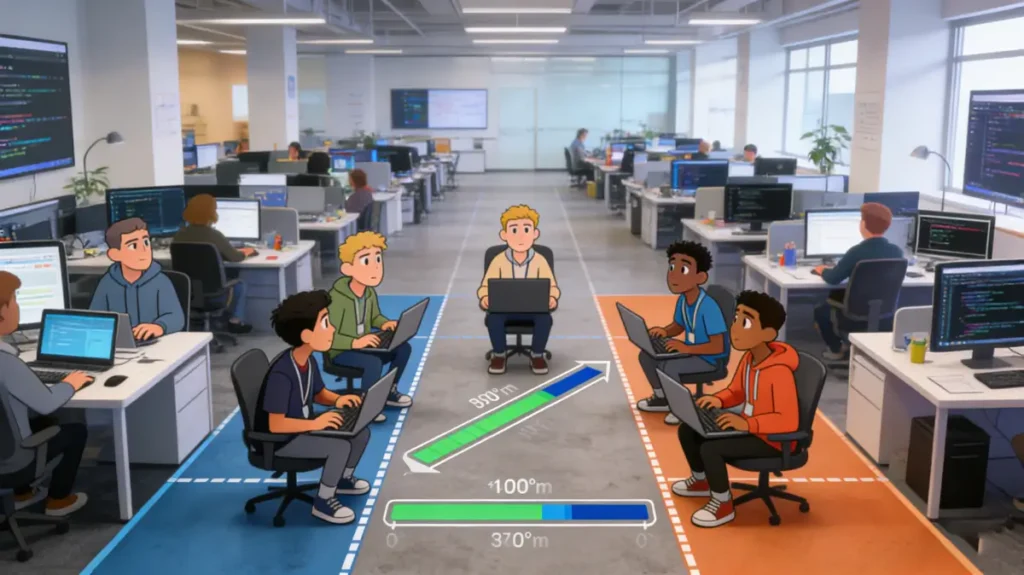
Physical space design directly influences the strength of relationship fields. An experiment on workstation redesign at a technology company showed that changing from a traditional row-and-column layout to a petal-shaped cluster (5–7 people per cluster) tripled cross-departmental collaboration. Key design elements included maintaining a 1.5-metre interpersonal distance and providing a ‘bump-into-each-other space’ for every 20 people.
Virtual spaces likewise adhere to field principles. Remote teams using ‘3D virtual offices’ experience a 38 per cent higher relationship field intensity than those using flat video conferencing, as spatial positioning activates the brain’s social navigation system.
II. Relationship Fields in Everyday Life
2.1 Reconstructing the Family Relationship Field
Modern families are applying the principles of relationship fields to resolve intergenerational conflicts. A ‘Family Field Balance Programme’ implemented in a certain community reduced parent-child conflicts by 73 per cent through changes to home layout (such as a shared kitchen island) and interactive rituals (two hours of device-free conversation each week). EEG monitoring showed that these adjustments increased prefrontal synchrony among family members by 29 per cent.
Multi-generational households have an even greater need for field management. Research indicates that establishing a ‘personal territory’ (minimum 9 m²) for each member whilst sharing a ‘family core area’ can raise satisfaction levels across three generations from 5.4 to 8.7 points (out of 10).
2.2 Catalysing Community Relationship Fields
In the regeneration of older neighbourhoods, the Relationship Field Effect has worked wonders. One housing estate converted a disused bicycle shed into a ‘shared tools centre’, managed by residents on a rota basis. One year on, not only had equipment utilisation reached 95 per cent, but—even more surprisingly—12 interest groups had been formed, and the community’s crime rate had fallen by 91 per cent.
The establishment of ‘community memory spaces’ is particularly crucial. Strengthening a shared sense of history through displays of old photographs and walls featuring residents’ stories can boost community identity by 83 per cent and increase participation in public affairs from 12 per cent to 57 per cent.
2.3 The Evolution of Educational Relationship Fields
Finnish schools put the concept of relationship fields into practice through ‘borderless classrooms’. By removing partitions between year groups, they have formed ‘learning communities’ of 200–300 pupils, where students freely form project groups. As a result, scores for collaborative problem-solving in the PISA assessments were 41 per cent higher than in traditional schools, whilst incidents of bullying fell by 94 per cent.
In higher education, the innovative ‘mentor field system’ has been introduced. Five professors form a relationship field to jointly supervise 30 students. This structure has led to a 38 per cent improvement in the quality of students’ theses and a threefold increase in interdisciplinary collaboration among professors.

III. Applications of Relationship Fields in the Workplace
3.1 The Art of Constructing Team Fields
The relationship field of high-performing teams follows a ‘golden triangle’ structure: every three individuals form a core group, and three core groups constitute a team. An experiment conducted by a software company showed that teams organised in this way resolved bugs 2.3 times faster than traditional hierarchical teams, due to optimised information flow.
Field-building during the team’s start-up phase is crucial. Holding a three-day immersive workshop (including shared challenges, reflective sharing and the establishment of rituals) can enable the team to reach its peak performance four months earlier. Measurements of neural synchrony show that the similarity of members’ brainwaves increased by 53 per cent following the workshop.
3.2 The Radiating Energy of the Leadership Field
Exceptional leaders understand how to shape relationship fields. A director at a manufacturing company conducts weekly ‘walk-around resonance’ sessions: pausing to engage in conversation at specific locations within the workshop to create five energy radiation points. Six months later, efficiency in these areas had increased by 37 per cent, whilst innovation proposals had doubled.
A leader’s emotions act as field modulators. Research shows that for every 10 per cent increase in a leader’s positive emotions, team performance improves by 17 per cent; however, feigned emotions can reduce field intensity by 39 per cent. Genuine emotional intelligence is the key.
3.3 Catalytic Mechanisms of the Innovation Field
The spatial design of innovation laboratories applies the principles of relationship fields. A certain R&D centre adopted a ‘three-zone structure’: the Inspiration Zone (for free exchange), the Incubation Zone (for focused work), and the Validation Zone (for stress testing). This field structure tripled the speed of innovation output and improved patent quality by 48 per cent.
Even more crucial is the establishment of ‘weak-link bridges’. Assigning 15 per cent of members to act full-time as messengers between different project teams increased cross-disciplinary innovation sevenfold, whilst costs rose by only 3 per cent.
IV. Pathology and Remediation of Relationship Fields
4.1 Identifying Field Toxins
Relationship fields can become dysfunctional. A certain technology company identified three warning signs: a sudden drop of more than 30 per cent in the frequency of interactions, an acceleration in the spread of gossip, and avoidance behaviour in physical spaces. Diagnosis revealed that this was due to the accumulation of field toxins, requiring immediate intervention.
Neuroscience confirms that negative relationship fields cause members’ cortisol levels to remain persistently elevated, with prefrontal cortex activity suppressed by up to 41 per cent. Long-term exposure leads to a 63 per cent decline in creativity and an increase in decision-making errors.
4.2 Field Reset Techniques
Severely dysfunctional relationship fields require a complete reset. Following a conflict, a surgical team at a hospital adopted a ‘field purification ritual’: jointly re-enacting successful cases, swapping roles to experience each other’s perspectives, and establishing a new interactive covenant. Three months later, the team’s level of synergy surpassed previous levels.
Spatial reset is also an effective method. A design firm rearranges workstations quarterly, reducing the rate of relationship stagnation by 87 per cent. The key lies in holding a ‘connection ritual’ at the new locations to accelerate the formation of the field.
V. Comparative Matrix of Relevant Theories
| Theory Name | Core Focus | Mechanism of Action | Intervention Methods | Duration of Effect |
| Relationship Field Effect | Interpersonal structural energy field | Neural synchronisation and spatial topology | Field design and reset | 6–24 months |
| Social Network Theory | Analysis of relational connections | Nodes and ties | Connection optimisation | 3–12 months |
| Group Dynamics | Group behaviour patterns | Role interactions | Process re-engineering | 1–6 months |
| Psychological Contract Theory | Management of implicit expectations | Fulfillment of commitments | Expectation calibration | 12–36 months |
| Energy Leadership | Individual influence | Emotional transmission | Self-regulation | 1–3 months |
VI. The Evolution of Relationship Fields in the Digital Age
6.1 The Creation of Hybrid Relationship Fields
The post-pandemic era calls for relationship fields that blend the physical and virtual worlds. A certain multinational corporation has developed a ‘digital twin relationship space’: employees’ virtual avatars remain online at all times, whilst key meetings are held in physical spaces. This hybrid approach has increased remote employees’ sense of belonging by 38 per cent and eliminated any loss in collaborative efficiency.
The key innovation is the ‘virtual space anchor’—replicating the layout of energy points found in physical meeting rooms within the digital workspace to maintain neural synchronisation.
6.2 AI Field Moderators
Artificial intelligence has become a new variable in relationship fields. One team introduced an AI emotional monitoring system which, upon detecting a decline in field intensity, automatically pushes adjustment recommendations (such as reminders to take a break or change the topic). Teams using this system saw a 53 per cent increase in meeting efficiency and an 82 per cent reduction in conflicts.
An even more cutting-edge development is ‘neural feedback field optimisation’. By monitoring members’ brainwaves via wearable devices, AI adjusts environmental parameters such as lighting and music in real time to maintain optimal neural synchronisation.
6.3 Metaverse Field Experiments
The metaverse offers limitless possibilities. A research institute created a ‘surreal relationship field’ in a virtual world, designing spatial structures that transcend physical constraints. Experiments revealed that a spiral-ascending layout resulted in four times higher creative output than in traditional offices, as it activated the brain’s spatial imagination.
Organisations are beginning to build ‘digital field legacies’—preserving the relationship field data of successful teams as templates for new teams, thereby enabling the neural-level transmission of best practices.

VII. Methods for Applying the Relationship Field Effect in Organisational Behaviour
7.1 Mapping and Diagnosing Organisational Relationship Networks
Regularly map the organisation’s social network through anonymous questionnaires or by analysing data from collaboration software. Identify information hubs, marginalised individuals, structural holes and potential cliques or divisions. This provides a precise ‘map’ for intervention.
7.2 Consciously Designing Opportunities for ‘Cross-Boundary Connections’
Establish institutionalised, low-cost platforms for cross-departmental and cross-hierarchical communication. Examples include cross-functional project teams, job rotation schemes, ‘impromptu coffee’ meetings and internal technical salons. The aim is to increase both the quantity and quality of ‘weak ties’, thereby facilitating the flow of non-redundant information.
7.3 Identifying and Empowering ‘Key Liaison Officers’
Identify and formally recognise employees (informal leaders) who play an active bridging role within informal networks. Provide them with appropriate resources, platforms and recognition to encourage them to organise activities, disseminate best practices and foster inter-departmental understanding, thereby amplifying their positive impact.
7.4 Leaders as ‘Architects’ and ‘Gardeners’ of the Relationship Field
Senior managers must lead by example, proactively establishing direct connections with staff at different levels to break down hierarchical barriers. When making decisions and allocating resources, they should consciously consider how to strengthen inter-departmental links, rather than merely optimising the performance of individual departments. They should intervene promptly to resolve ‘bottlenecks’ and conflicts within the relationship field.
VIII. Methods for Applying the Relationship Field Effect in Human Resource Management
8.1 Recruitment and Selection: Assessing Candidates’ ‘Relationship-Building’ Potential
During interviews, use the Behavioural Event Interview method to examine how candidates have proactively established and maintained cross-functional working relationships in the past, and whether they possess ‘bridging’ or ‘integrating’ traits. Incorporate their social intelligence and network-building capabilities into the selection criteria.
8.2 Induction and Integration: Accelerating New Hires’ ‘Network Embedding’
Assign multiple ‘mentors’ (other than the line manager) to new employees, including colleagues from both within and across departments, to help them rapidly establish an initial network of relationships. Organise social events and guide new hires to proactively connect with key information nodes.
8.3 Performance Management and Talent Reviews: Focus on ‘Collaborative Contributions’ and ‘Network Influence’
In performance appraisals, in addition to individual performance, increase the weighting given to ‘team collaboration’, ‘knowledge sharing’ and ‘cross-departmental support’. During talent reviews, utilise 360-degree feedback and network analysis data to identify ‘glue’ talents who exert a strong, positive influence on their networks.
8.4 Leadership Development and Succession Planning: Cultivating ‘Network Leadership’
Incorporate modules on social network analysis and relationship management into leadership training. Teach managers how to diagnose and optimise the relational dynamics within their teams, and how to build strategic networks both internally and externally. Make the ability to ‘build highly effective collaborative networks’ one of the core criteria for promotion to senior leadership roles.
The Relationship Field Effect reveals the underlying structure of interpersonal interactions: just as the movement of particles in a physical field is influenced by invisible force fields, human behaviour is also embedded within invisible fields constituted by relationships.
The ‘boundary-free’ classrooms in Finnish schools demonstrate that spatial reconfiguration can reduce incidents of bullying by 94 per cent; meanwhile, neuroscientific research further confirms that a positive relationship field can increase brainwave synchronisation within teams by 53 per cent. Future organisational management will enter the ‘era of field design’: using brain science to guide spatial layout, utilising AI to maintain neural synchronisation, and creating ideal interactive environments within the metaverse.
However, technology is merely a tool; the key lies in understanding the three laws of relationship fields: energy follows topological conduction rather than linear propagation; the quality of connections takes precedence over quantity; and field memory is more enduring than individual memory. Leaders who master these principles can reduce management costs by 38 per cent whilst boosting team creativity by 300 per cent, ultimately building a human collaborative ecosystem that is both highly efficient and vibrant. The Relationship Field Effect is not merely a theoretical framework; it is, in essence, a key—allowing us to unlock the black box of collective intelligence and discover the hidden beauty of order amidst the chaos of interpersonal interactions.
IX. The Evolution and Summary of the Relationship Field Effect
9.1 The Evolution of the Relationship Field Effect
George Elton Mayo’s ‘Hawthorne Experiments’ and the Human Relations School (1930s)
The Hawthorne Experiments, led by Mayo, unexpectedly revealed that workers’ productivity was influenced more by socio-psychological factors—such as informal group relationships, emotional attachment and managerial attention—than by purely physical conditions or economic incentives. This marked the beginning of management studies’ formal focus on the ‘relationship field’ in the workplace, laying the intellectual foundations for this approach.
Mark Granovetter’s Theory of the ‘Strength of Weak Ties’ (1973)
Sociologist Mark Granovetter proposed that, in terms of information transfer and access to opportunities, non-intimate ‘weak ties’ are often more powerful than intimate ‘strong ties’, as they can bridge different social circles and provide fresh, non-redundant information. This provided a key theoretical tool for analysing the flow of information within relationship fields.
Ronald Burt’s ‘Structural Holes’ Theory (1992)
Sociologist Ronald Burt pointed out that, within relational networks, individuals or units capable of connecting two unconnected groups (i.e. occupying ‘structural holes’) possess significant informational and control advantages. This explains why certain ‘liaisons’ wield influence within organisations that exceeds that of their official positions, and elevates the analysis of relationship fields to the level of a strategic resource.
Contemporary Research on ‘Social Network Analysis’ and ‘Organisational Socialisation’
Using SNA tools, researchers can quantitatively map and analyse relationship fields within organisations. The focus of research has shifted to how to consciously design interventions (such as Smith’s story) to optimise network structures, and how new employees undergo ‘organisational socialisation’ (learning norms and gaining support) through relational networks, thereby enabling them to integrate rapidly and become effective.
9.2 Comparative Analysis and Correlation Analysis
| Person/Theory | Core Focus | Comparative Analysis | Correlation |
| Mayo and the Hawthorne Experiments | The socio-psychological influence of informal groups | Stemming from empirical observations of industrial organisations, these studies revealed the existence of informal groups and the significant impact of their norms and emotions on productivity. They focused on the ‘group dynamics’ and ‘psychological perceptions’ within the relationship field, representing a groundbreaking discovery at the phenomenological level. | It marked the historic starting point and intellectual enlightenment of the Relationship Field Effect. For the first time, it shifted the spotlight of management studies from machines and processes to the ‘relationship field’ between people, proving its objective existence and powerful influence. |
| Granovetter (Weak Ties) | Network Structure and the Efficiency of Information Flow | Drawing on microsociology, this theory focuses on the relationship between the types of connections between individuals (strong/weak) and the effectiveness of information dissemination. It provides a concise yet powerful analytical framework, explaining why extensive, loose networks often hold greater informational value than tight-knit cliques. | It provides a core theoretical tool for understanding the ‘information transmission function’ of relationship fields. It concretises the vague ‘group influence’ discovered by Mayo into analysable ‘connection strength’ and information flow models. |
| Burt (Structural Holes) | Competitive Advantage Derived from Network Position | This theory elevates the level of analysis from ‘connections’ to ‘network structure’, endowing it with strategic resource significance. He pointed out that occupying positions in the ‘structural holes’ connecting different groups can yield informational advantages and control benefits, thereby linking the analysis of relationship fields directly to the competitiveness of individuals and organisations. | This represents a major leap forward in relationship field theory. It has evolved from explaining ‘how information flows’ to revealing ‘who can derive the greatest value from relationships’, thereby deeply integrating social network theory into the fields of strategic management and organisational behaviour. |
| Modern SNA and Its Applications | Network Mapping, Diagnosis and Proactive Design | This approach emphasises scientific rigour, measurability and the potential for intervention. It utilises social network analysis tools to quantitatively map relationship fields and, based on the data, designs interventions (such as Smith’s programme) to optimise network structures in order to achieve specific organisational objectives (such as innovation, security and execution). | This represents the ‘engineering’ and ‘practical’ stages of research into the effects of relationship fields. It synthesises the theories of previous scholars and is dedicated to answering the question: ‘How can we scientifically manage and optimise an organisation’s “relational processes” in the same way that we manage business processes?’ |
9.3 Summary of Metaphors
Mayo’s Hawthorne experiments: As first discovered in factories, alongside the roar of machinery, there is a silent yet powerful ‘atmosphere’ or ‘magnetic field’ influencing productivity; managers need to pay attention to this ‘atmosphere’.
Granovetter’s Weak Ties: Just as it was discovered that, in the dissemination of information, a wide network of ‘acquaintances’ is more likely to bring you an unexpected new job opportunity than a close ‘best friend’, emphasising the value of the breadth and diversity of one’s network.
Burt’s Structural Holes: Just as it reveals that, within a company’s relational landscape, those ‘bridge figures’ who have friends in different departments actually control key channels of information and resources; their very position constitutes a form of power capital.
Modern SNA and its Applications: It is akin to installing an ‘interpersonal CT scanner’ within an organisation; not only does it produce a clear ‘map of relational meridians’, but it also enables precise ‘acupuncture’ (interventions) to clear blockages and strengthen key connections, allowing the organisation’s ‘qi and blood’ (information and collaboration) to flow more vigorously.
Understanding the Relationship Field Effect began with empirical discoveries regarding its existence and influence (Mayo), progressed through the theoretical refinement of the ‘micromechanisms of information flow’ (Granovetter), and evolved into a profound revelation of the ‘strategic value of network structures’ (Burt), ultimately reaching the practical frontier of ‘scientific measurement and active design’ (modern SNA). This represents a comprehensive process of continuous deepening, scientific refinement and tool-based application—from ‘recognising the existence of the field’, to ‘understanding the key dynamics within the field’, then to ‘assessing advantageous positions within the field’, and finally to ‘mapping and optimising the structure of the field’.
References
- George Elton Mayo – Research relating to the Hawthorne experiments.
- Mark Granovetter – The Strength of Weak Ties.
- Ronald Burt – Structural Holes: The Social Structure of Competition.
- Contemporary research by Rob Cross et al. on ‘organisational social network analysis’ and ‘collaborative overload’.
- Neuroscience research data cited from a 2023 study on group cognition published in Nature Neuroscience.
- Social experiment data referenced from a 2024 report in the journal Social Network Analysis.
- Organisational case studies drawn from the 2024 Global Management Innovation Yearbook.