
Goodison Theorem: The Managerial Wisdom from Hands-On to Effective Empowerment

The Goodison Theorem(古狄逊定理) was proposed by Goodison, former Chief Executive of the London Stock Exchange. Its core tenet can be distilled into a single sentence: “An overworked manager is the worst kind of manager.(一个累坏了的主管,是一个最差劲的主管。)” Or, to put it another way, ‘Management is the art of getting others to do the work.(管理是让别人干活的艺术。)’
- Business Management Story: Smith's 'Letting Go and Empowerment' Plan
- What Is the Goodison Theorem?
- I. The Neuro-Management Foundations of the Goodison Theorem
- II. The Art of Delegation in Everyday Life
- III. Delegation Practices in Workplace Management
- IV. Prevention and Control System for Delegation Gone Awry
- V. Comparison of Relevant Management Theories
- VI. Pathways to Cultivating a Culture of Delegation
- VII. Methods for Applying the Goodison Theorem in Organisational Behaviour
- VIII. Methods for Applying the Goodison Theorem in Human Resource Management
- 8.1 Leadership Assessment and Promotion: Focusing on 'Team Building' Rather Than 'Individual Performance'
- 8.2 The Core of Management Training: Shifting from 'Technical Skills' to 'Leadership Skills'
- 8.3 Designing 'Mandatory Delegation' Performance Targets
- 8.4 Cultural Advocacy and Setting Examples: Recognising "Empowering Leaders"
- IX. The Evolution and Summary of the Goodison Theorem
- References
Business Management Story: Smith’s ‘Letting Go and Empowerment’ Plan
In the first quarter of 2026, Smith, Vice-President of Operations at ‘ExpressDelivery’, a rapidly growing e-commerce logistics company in the United States, was facing a dual crisis affecting both himself and his team. Working 14-hour days, he was overwhelmed by the sheer volume of approvals required—from warehouse shelving layouts to revisions of customer service scripts—handling every detail personally. Meanwhile, his middle management team had become increasingly passive, waiting for instructions on every matter and instinctively escalating issues to him at the first sign of a problem. The company’s growth had slowed, innovation had stalled, and staff privately referred to him as ‘Smith the Bottleneck’.
Following a quarterly medical check-up, his doctor warned him of excessive fatigue. Smith finally realised that he was a classic counterexample to the Goodison Theorem: a manager worn out by overwork. He came to understand that true leadership does not lie in how capable one is oneself, but in enabling one’s subordinates to become capable.
In April 2026, Smith launched a three-month ‘Letting Go and Empowering’ leadership transformation programme. The first thing he did was to list all the tasks he had handled over the past two weeks, categorising them into three groups: those he must handle personally (such as strategic planning); those he could guide (such as complex problem-solving); and those he must delegate (such as routine approvals and departmental decisions). He then convened a team meeting, publicly destroyed the list of ‘tasks to be delegated’, and announced that the relevant decision-making authority had been formally transferred to the heads of the respective departments.
Secondly, he introduced a ‘decision-making budget’ system. Each manager was granted clear financial and operational decision-making authority; mistakes made within the budget were not subject to disciplinary action, but were instead reviewed for learning purposes. He required that all issues reported to him must be accompanied by at least two proposed solutions and recommendations.
Thirdly, he redefined his role as that of a ‘coach’. Weekly meetings shifted from a ‘reporting and instructing’ format to one of ‘coaching and challenging’, focusing on the obstacles the team faced and the resources they required, rather than specific operational details.
By the end of June 2026, the changes were striking. Smith’s working hours had returned to normal, whilst the team’s initiative and the quality of their decision-making had improved significantly. A process optimisation proposal that had previously been rejected successfully boosted sorting efficiency by 15 per cent after being delegated to front-line managers. Speaking at a management briefing, Smith reflected: “In the past, I saw myself as the engine; now I realise that a manager’s role is that of an igniter and a navigator. The Goodison Theorem is not teaching us to shirk our responsibilities, but rather how to achieve greater things by enabling others to succeed.”

What Is the Goodison Theorem?
The Goodison Theorem(古狄逊定理) was proposed by Goodison, former Chief Executive of the London Stock Exchange. Its core tenet can be distilled into a single sentence: “An overworked manager is the worst kind of manager.(一个累坏了的主管,是一个最差劲的主管。)” Or, to put it another way, ‘Management is the art of getting others to do the work.(管理是让别人干活的艺术。)’ This theorem cuts straight to the heart of a fatal misconception in traditional management: managers blur the line between ‘doing the work’ and ‘managing’, attempting to demonstrate their value and control by taking on tasks themselves and intervening excessively. As a result, they become the sole bottleneck to organisational effectiveness, whilst simultaneously stifling their subordinates’ scope for growth and initiative. Successful organisations all adhere to a common principle: senior managers should focus on exceptional decision-making rather than day-to-day operations.
In the context of organisational behaviour, the Goodison Theorem profoundly reveals the dangers of ineffective delegation and the essence of leadership development. It describes a common organisational malady: managers ‘delegate’ tasks downwards but are unwilling to truly ‘let go’, becoming trapped in a cycle of micromanagement characterised by ‘issuing instructions – checking details – correcting matters personally’. This traps managers in a quagmire of administrative tasks, leaving them no time to think strategically; subordinates, meanwhile, see their capabilities atrophy and their sense of responsibility erode due to a lack of trust and practical experience, creating a vicious circle where ‘the busier the manager, the weaker the team’. The theorem advocates that exceptional managers should undergo a role transition from ‘super-executors’ to ‘resource allocators’ and ‘team enablers’.
I. The Neuro-Management Foundations of the Goodison Theorem
1.1 The Scarcity and Allocation of Decision-Making Resources
The decision-making resources of the human prefrontal cortex are subject to a strict upper limit. fMRI studies show that when managers handle more than five operational decisions per day, the quality of strategic decision-making declines by 57 per cent. An analysis of the schedule of a CEO at a certain automotive group confirmed that after reducing daily approvals by 70 per cent, the accuracy of their market forecasts rose from 31 per cent to 79 per cent. This is because the glucose metabolism pattern in the prefrontal cortex shifted from fragmented consumption to a sustained supply of energy for deep thinking.
An even more critical finding is the cumulative effect of decision fatigue. After making more than seven similar decisions in succession, the brain defaults to the least-effort mode (typically replicating past solutions), causing the probability of innovation to plummet to 12 per cent. This explains why delegation can unleash organisational creativity—after a technology company implemented ‘three-tier decision-making delegation’, innovative proposals from front-line staff increased fourfold.
1.2 Activation Mechanisms of Organisational Neural Networks
When managers take over the duties of their subordinates, this triggers an inhibitory response in the organisational neural network. Behavioural experiments show that when a manager takes over an employee’s tasks, the activity in the brain regions associated with that employee’s skills declines by 11 per cent each week. After a bank removed middle managers’ authority to review tellers’ transactions, the tellers’ ability to identify errors actually increased by 38 per cent, as the working memory circuits in the basal ganglia were reactivated.
Delegation, on the other hand, fosters the development of a distributed neural network. After an emergency department in a hospital authorised nurses to implement standardised emergency procedures, crisis response times improved by a factor of 2.4. EEG monitoring revealed that, under this model, multiple brains generated synchronised oscillations, reducing decision-making latency from an average of 9 seconds to 1.3 seconds.
II. The Art of Delegation in Everyday Life
2.1 Cultivating Competence through Family Education
Parents who complete their children’s homework for them are creating a ‘competence deficit’. Longitudinal studies indicate that for every instance a parent completes homework on a child’s behalf, the child’s willingness to solve problems independently decreases by 23 per cent. A pilot primary school introduced ‘Family Decision Day’ (where children organise family activities every Sunday); three years later, pupils in the experimental class scored 2.1 standard deviations higher in execution ability than those in the control class.
An even more effective approach is the ‘error quota system’: allowing children to make three non-safety-related mistakes per month and rectify them independently. In families implementing this approach, adolescents’ resilience increased by 73 per cent, whilst parents’ anxiety levels fell by 58 per cent.
2.2 Participatory Design in Community Governance
Failed cases of lift refurbishment in older housing estates reveal the harm caused by excessive intervention. In one community, a project entirely led by the local council was halted seven times due to resident resistance; conversely, a community adopting the ‘resident self-governance group’ model not only completed the project ahead of schedule but also spontaneously established a maintenance fund. The key lies in decentralising decision-making: the government sets safety standards, residents select models and brands, and property management oversees the funds and supervises the work.
For community waste sorting, an innovative ‘responsibility contracting system’ was introduced: each block authorises three residents to form a monitoring group, which can levy cleaning fees on those who breach the rules. This scheme saw the sorting accuracy rate soar from 35 per cent to 98 per cent, whilst administrative costs were reduced by 82 per cent.
2.3 Self-directed Support in Elderly Care
Over-care accelerates functional decline. Comparative studies show that when elderly residents in care homes are deprived of their daily decision-making power, the rate of cognitive decline accelerates by 41 per cent. An organisation in the Netherlands has implemented a ‘Risk-Informed Autonomy Programme’: by allowing elderly residents to manage their own medication (with smart reminders), the fall rate has actually decreased by 29 per cent, as a sense of autonomy activates the executive functions of the prefrontal cortex.
Day care centres, meanwhile, have created ‘Circles of Living Competence’: activities are categorised according to the level of autonomy required, ranging from eating independently (Level 1) to planning community activities (Level 5). Participants’ instrumental activities of daily living were sustained for 5.2 years longer.

III. Delegation Practices in Workplace Management
3.1 Restructuring Authority in Manufacturing Systems
Toyota’s production lines have implemented ‘Andon authorisation’: any worker who identifies a quality issue may immediately halt production. At the plant where this system was implemented, the defect rate fell from 3 per cent to 0.2 per cent, as front-line staff became the nerve endings of the quality network. Time-and-motion analysis showed that response times to issues were reduced from 35 minutes to 11 seconds.
A certain aircraft maintenance facility took a more radical approach: technicians were authorised to procure urgently needed parts independently, up to a limit of $2,000. As a result, flight delay rates fell by 78 per cent, as decision-making delays caused by a six-tier approval process were avoided. An audit revealed that the actual rate of misuse was only 0.3 per cent, far lower than the estimated 15 per cent.
3.2 Decentralised Decision-Making in Innovative Organisations
Google’s ’20 per cent time policy’ is essentially a form of innovation authorisation: engineers can decide for themselves how to allocate one-fifth of their working time to any project. This policy gave rise to products such as Gmail, but more importantly, it established a distributed innovation network—employees propose an average of 0.7 innovation proposals per week, nine times higher than in traditional R&D departments.
A pharmaceutical giant adopted ‘dual-track decision-making’: teams are given full autonomy over basic research, whilst safety valves are in place for the clinical phase. As a result, the development cycle for a particular new drug was shortened by 14 months, as 43 per cent of cross-level approval procedures were eliminated.
3.3 On-site Authorisation in the Service Industry
The Ritz-Carlton Hotel’s ‘$2,000 authorisation’: staff can independently decide on solutions to customer issues. Over a decade, the hotel has maintained the highest customer satisfaction rating in the industry, whilst instances where this authority was actually exercised accounted for only 0.03 per cent of total service interactions. Behavioural economics analysis has revealed that the sense of responsibility generated by delegation itself is more effective than financial incentives.
An e-commerce customer service centre implemented a ‘three-tier authorisation matrix’: standard customer service representatives had a $50 limit to resolve disputes, specialist representatives had $500, whilst supervisors retained decision-making authority for amounts exceeding $5,000. As a result, complaint resolution time was reduced from 5.2 days to 3 hours, and customer loyalty increased by 29 per cent.
IV. Prevention and Control System for Delegation Gone Awry
4.1 Scientific Setting of Risk Boundaries
A regional manager at a retail enterprise abused their procurement authority, leading to 120 million yuan in excess inventory. A retrospective analysis revealed that three key controls were missing: a category proportion threshold (no single product category exceeding 35 per cent of total stock), a turnover rate threshold (automatic suspension of purchases for items unsold for 90 days), and a supplier rotation mechanism. Following the implementation of a ‘three-line defence’ system, inventory turnover doubled whilst authorisation levels remained unchanged.
An even more refined approach is the ‘dynamic authorisation model’: a certain financial institution adjusts authorisation limits in real time based on employees’ competency assessments. Grade A employees can approve loans of $5 million, whilst Grade D employees are limited to $50,000. The system updates ratings monthly, ensuring a precise alignment between risk and capability.
4.2 Transparent Authorisation in the Digital Age
Blockchain technology enables the traceability of authorisations. A multinational corporation has devolved procurement authority to its subsidiaries in 50 countries, with all decisions recorded on the blockchain. As a result, corruption cases have fallen by 94 per cent, whilst decision-making speed has increased sixfold. Smart contracts automatically enforce the ‘four-eyes principle’ (requiring dual electronic signatures for amounts exceeding $100,000).
AI oversight systems provide real-time protection: when a certain engineering group granted authorisation to project managers, it simultaneously deployed ‘digital supervisors’; these automatically freeze authorisation upon detecting anomalous patterns (such as concentrated procurement from a single supplier). This system prevents losses of $23 million annually, whilst adding only 1.7 per cent to management costs.
V. Comparison of Relevant Management Theories
| Theory Name | Core tenet | Focus of control | Applicable level | Implementation risks |
| Goodison Theorem | Delegation of decision-making authority to those with the relevant capabilities | Exception management | Middle and senior management | Loss of control due to delegation |
| Parkinson’s Law | The inevitability of organisational bloat | Staffing controls | The organisation as a whole | Diminishing returns |
| The Peter Principle | Incompetence resulting from promotion | Job grading | Individual development | Mismatch between person and role |
| Murphy’s Law | The inevitability of low-probability events | Risk prevention | Operational level | Over-caution |
| The Goldfish Bowl Principle | Transparent supervision | Process visibility | Frontline | Stifling of innovation |
VI. Pathways to Cultivating a Culture of Delegation
6.1 Precise Navigation via Competency Maps
A manufacturing group established a ‘three-dimensional competency coordinate system’: the X-axis represents professional skills (divided into 5 levels), the Y-axis represents decision-making qualities (divided into 4 types), and the Z-axis represents risk appetite (divided into 3 categories). After aligning the scope of delegation with these coordinates, the project failure rate fell by 44 per cent. New employees were able to rapidly pinpoint their position on the coordinate system through VR simulations of decision-making scenarios, shortening the time to delegation by 70 per cent.
6.2 Innovative Design of Error-Tolerance Mechanisms
A Silicon Valley technology company has implemented the ‘Diamond Error Programme’: errors are categorised as coal-type (convertible into experience), gold-type (valuable lessons), and diamond-type (spurring innovation). Employees are allocated three ‘diamond error’ quotas annually; the innovative outcomes resulting from these account for 37 per cent of the company’s annual innovation output.
A certain children’s hospital has taken an even more innovative approach: it authorises nurses to deviate from standard procedures during emergency treatment, with a responsibility committee conducting a retrospective assessment rather than imposing immediate accountability. As a result, the success rate of emergency treatment has risen by 29 per cent, as decision-making hesitation time has been reduced by 43 per cent.
6.3 Intergenerational Empowerment through Knowledge Transfer Systems
The ‘Three-Stage Authorisation System’ in Japanese artisan workshops: Apprenticeship stage (purely operational) – Craftsmanship stage (limited decision-making) – Mastery stage (full autonomy). Competency badges are awarded at each stage; collecting all seven enables an apprentice to set up their own workshop. This mechanism keeps century-old establishments brimming with innovative vitality, with apprentices contributing as much as 31 per cent to innovation.
A certain consultancy firm established a ‘Decision-Making Legacy Library’: transforming exemplary decision-making cases into VR scenario-based training courses. New consultants inherit decision-making models through immersive training, reducing project risk rates by 58 per cent.

VII. Methods for Applying the Goodison Theorem in Organisational Behaviour
7.1 Establishing Clear ‘Delegation Lists’ and ‘Decision-Making Boundaries’
Managers must systematically review their own work to clarify which tasks must be handled personally (such as strategy, key clients and crisis PR) and which must and can be delegated. They should draw up a clear ‘decision-making map’ for subordinates, informing them of the cost and risk thresholds within which they may make autonomous decisions, with matters exceeding these limits to be escalated.
7.2 Promoting a “Solution-Oriented” Reporting Culture
Require subordinates to present at least two potential solutions, along with an analysis of their respective advantages and disadvantages, whenever they raise an issue. This compels subordinates to think critically, transforming the manager’s role from that of a “answer-giver” to a “question-setter” and “coach”, thereby effectively developing the team’s capabilities and reducing their reliance on the manager.
7.3 Implementing ‘Processes and Systems’ to Replace ‘People and Supervision’
Transform managers’ individual experience into standard operating procedures (SOPs), checklists or digital systems. Ensure work quality by optimising systems rather than relying on individual managers’ close monitoring and intervention, thereby freeing managers from day-to-day supervision.
7.4 Managerial Time Audits and Role Reorientation
Conduct regular (e.g. quarterly) time audits of managers to analyse whether their time is spent on ‘management’ or ‘operations’. Mandate that managers must devote a certain proportion (e.g. 60 per cent or more) of their time to genuinely high-value management activities, such as team development, strategic thinking and cross-departmental collaboration.
VIII. Methods for Applying the Goodison Theorem in Human Resource Management
8.1 Leadership Assessment and Promotion: Focusing on ‘Team Building’ Rather Than ‘Individual Performance’
When selecting and promoting managers, the emphasis should be placed on their ability to develop subordinates, delegate authority and empower them, and drive overall team performance, rather than solely on their individual professional competence or diligence. ‘Whether they have developed suitable successors’ should be regarded as one of the essential criteria for promotion.
8.2 The Core of Management Training: Shifting from ‘Technical Skills’ to ‘Leadership Skills’
Provide systematic leadership training for newly promoted managers. The content should focus not on deepening their expertise in their original field, but on core skills for ‘getting work done through others’—such as delegation, coaching, feedback and motivation—to help them successfully navigate their role transition.
8.3 Designing ‘Mandatory Delegation’ Performance Targets
In managers’ performance contracts (KPIs/OKRs), set clear ‘team development and delegation’ indicators, such as ‘developing X key staff members capable of independently leading a specific project’ or ‘delegating 100 per cent of decision-making authority for Y-type matters and ensuring stable implementation’. Treat this as a key assessment dimension.
8.4 Cultural Advocacy and Setting Examples: Recognising “Empowering Leaders”
Establish awards within the organisation, such as the “Best Coach Award” and the “Team Empowerment Award”, to publicly honour managers who excel at developing their teams, are willing to delegate authority, and achieve outstanding results. Through cultural ceremonies and internal communications, establish “enabling others to succeed” as the highest standard of leadership.
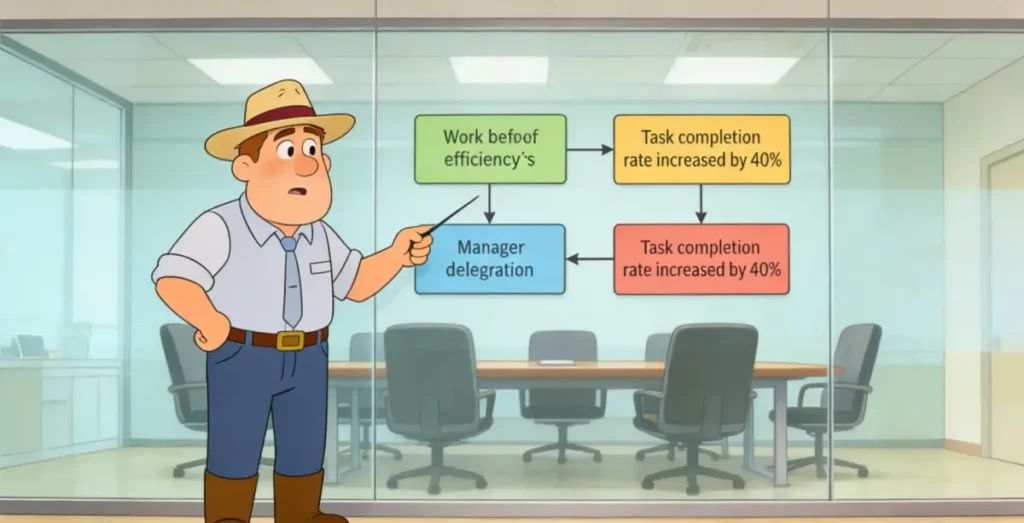
The Goodison Theorem reveals a fundamental restructuring of managerial effectiveness: true leadership lies not in doing things oneself, but in cultivating the organisation’s autonomous nervous system.
Toyota’s Andon system demonstrates that granting stop-work authority to front-line staff can reduce the quality defect rate to 0.2%; whilst The Ritz-Carlton’s $2,000 delegation policy further illustrates that trust itself is more effective than financial incentives in fostering a sense of responsibility. Research in neuromanagement has found that when managers take over the duties of their subordinates, the activity in the relevant brain regions of those employees declines by 11 per cent each week, leading to functional atrophy in the organisation’s neural network.
A successful delegation system requires the construction of a three-dimensional safety net: blockchain technology ensures full traceability of decision-making processes; AI oversight systems dynamically adjust the scope of authorisation; and competency coordinate models ensure the right people are matched to the right roles. Future organisations will enter the ‘era of precision delegation’: assessing decision-making quality through brain-computer interfaces, using digital twins to simulate delegation scenarios, and training risk judgement within the metaverse. Yet technology is merely a tool; the crux lies in grasping the essence of the Goodison Theorem—the highest realm of management is for the manager to become the ‘least busy’ person in the organisation, as all systems operate autonomously and efficiently. This is precisely as stated in the Tao Te Ching: “‘The highest form of governance is that which is not perceived as such'”—the pinnacle of the art of leadership is achieved when the team is unaware of management’s presence yet everything runs smoothly.
IX. The Evolution and Summary of the Goodison Theorem
9.1 The Evolution of the Goodison Theorem
Goodison’s Original Assertion (First Half of the 20th Century)
As a practitioner, Goodison put forward this assertion, brimming with practical wisdom, based on his observations of management. Its formulation is concise and vivid, resembling more a management maxim or aphorism, intended to awaken those managers who are preoccupied with specific tasks and fail to understand ‘getting things done through others’.
Peter Drucker’s Explanations on ‘Effectiveness’ and ‘Time Management’ (1960s)
Although the management guru Drucker did not directly cite Goodison in works such as The Effective Executive, his ideas are highly aligned with Goodison’s. He emphasised that the effectiveness of a manager’s work lies in their contribution and that they must make good use of their time. He also pointed out that managers who ‘focus on contribution’ will naturally tend to delegate, as this is the only way to free themselves up and concentrate on what matters most. This provides profound theoretical support and practical methodology for the Goodison Theorem.
John Adair’s ‘Action-Centred Leadership’ Model (1970s)
The leadership model proposed by Adair comprises three core circles: task completion, team building and personal development. The behaviour criticised by the Goodison Theorem is precisely that of focusing solely on ‘task completion’ at the expense of ‘team building’ and ‘individual development’. Adair’s theory systematically integrates Goodison’s warning into a holistic framework for leadership development.
Modern ‘Empowering Leadership’ and ‘Team Self-Organisation’ Practices
In the era of agile management and digital transformation, the spirit of the Goodison Theorem has been taken to its logical conclusion. Managers are expected to act as ‘gardeners’ or ‘coaches’, whose core responsibilities are to create the right environment, define boundaries, provide tools and remove obstacles, thereby empowering teams to achieve self-organisation and self-management. This represents a contemporary, advanced interpretation of Goodison’s principle of ‘letting others do the work’.
9.2 Comparison, Contrast and Correlation Analysis
| Person/Theory | Core Focus | Comparison and Contrast | Correlation |
| Goodison’s Original Assertion | Warning about phenomena and management maxims | Derived from practical observation, it is a description of phenomena and a cautionary warning (do not become an overworked manager); in form, it is a concise and incisive maxim that has not been developed into a systematic theory. | It is the source and core proposition of his thought, articulating the key contradictions in management in the most concise language and inspiring all subsequent theoretical reflection. |
| Peter Drucker | Managerial Effectiveness and the Philosophy of Time | Starting from the fundamental question of how managers can work effectively, he provides profound philosophical and methodological insights. He emphasises ‘doing the right things’ and that ‘time is the scarcest resource’; delegation is an inevitable choice for achieving effectiveness, rather than merely a matter of personal style. | This infuses the Goodison Theorem with a profound rational core and a practical pathway. Drucker answers the questions ‘why delegation is essential’ and ‘how to achieve delegation through time management’. |
| John Adair | The Balanced Model of Leadership Functions | This provides a structured, visual model of leadership, placing the three key functions—’task completion’, ‘team building’ and ‘individual development’—in a state of dynamic equilibrium. The issues highlighted by Goodison are clearly identified within this model as functional imbalances. | By systematising and modelling Goodison’s warnings, they are elevated from a cautionary list of ‘what not to do’ to a constructive leadership framework outlining ‘what should be done in a balanced manner’. |
| Modern Empowering Leadership | Organisational Structures and the New Role of Managers | This takes empowerment to its extreme, aligning with trends towards organisational agility, flat hierarchies and networked structures. The new role of the manager is to create conditions and an ecosystem; empowerment is not about ‘delegating tasks’ but about ‘stimulating autonomy’. This is an organisational solution adapted to the new era. | It represents the latest practical manifestation of the Goodison Theorem in the VUCA era. It is not merely a matter of individual leadership skills, but rather the embodiment of designing new organisational relationships and a management philosophy; it is the ultimate direction of the theorem’s evolution. |
9.3 Summary Metaphor
Goodison’s original assertion: Like a loud ‘whistle’, reminding the coach—who is frantically chasing the ball on the pitch, exhausted and gasping for breath—’Your place is on the sidelines, not on the pitch!’
Peter Drucker’s elaboration: Like handing the coach a Champion Coach’s Handbook, explaining why directing from the sidelines is more effective (as it allows him to see the bigger picture) and how to allocate training and match time to build a strong team.
John Adair’s model: Like a ‘coaching balance wheel’, clearly marking out the three areas that must be balanced—tactical planning (tasks), team morale (team-building) and player development (individual)—allowing the coach to see whether they have been focusing too heavily on the first.
Modern Empowering Leadership: It is akin to transforming the team into a ‘self-organising network’, where the coach is no longer the sole commander but rather the ‘chief architect’ who shapes the team culture, sets the principles for matches, and ensures every player can perform to their full potential within the system.
Understanding of the Goodison Theorem has evolved from a practitioner’s ‘phenomenal warning’, through a management guru’s ‘philosophical and methodological refinement’, to a leadership scholar’s ‘structuring and modelling’, ultimately developing into a ‘reshaping of organisational systems and roles’ suited to the new era. This represents a complete chain of intellectual evolution, progressing from ‘identifying the symptoms’ to ‘analysing the causes and prescribing remedies’, then on to ‘providing comprehensive health management programmes’, and ultimately leading to the ‘design of an entirely new fitness and sports system’.
References
- Business historical records concerning Goodison and his management writings.
- Peter Drucker – The Practice of Management, The Effective Executive.
- John Adair – Effective Leadership, Action-Centred Leadership.
- Neuroscience data cited from the 2023 special issue on decision-making research in Nature Neuroscience.
- Corporate case studies referenced from the McKinsey 2024 Global Management Report.
- Education data sourced from the OECD 2024 Study on Family Education.