Hobson Choice Effect: Breaking the Innovation Shackles of False Choices

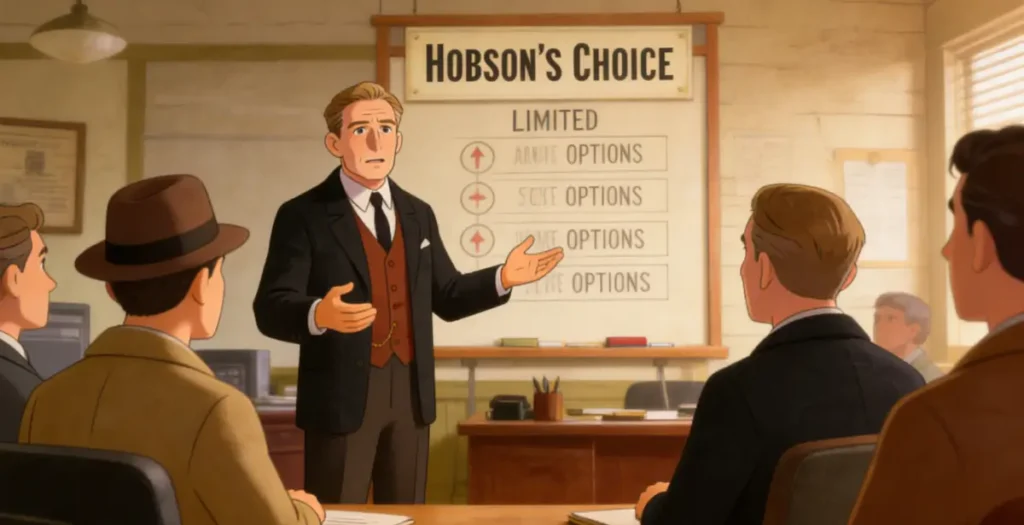
The Hobson Choice Effect(霍布森选择效应) originates from a historical anecdote: in 17th-century Cambridge, England, a carriage hireman named Hobson stipulated that customers could only choose the horse closest to the door when hiring a horse, or else they would not be hired.
- Business Management Story: Smith's 'Breaking the False Dilemma' Initiative
- What Is the Hobson Choice Effect?
- I. The True Story of the Cambridge Stables
- II. The Psychological Mechanisms of the Hobson Choice Effect
- III. The Hobson Choice Effect in Everyday Life
- IV. The Hobson Choice Effect Strategies in the Workplace
- V. Comparative Analysis of Relevant Decision-Making Effects
- VI. Model for the Synergistic Application of Effects
- VII. Identification and Defence Strategies
- VIII. Methods for Applying the Hobson Choice Effect in Organisational Behaviour
- IX. Methods for Applying the Hobson Choice Effect in Corporate Human Resource Management
- X. The Evolution and Summary of the Hobson Choice Effect
- References
Business Management Story: Smith’s ‘Breaking the False Dilemma’ Initiative
In early 2026, Smith, Vice-President of Product Lines at ‘Rich & Classic’, a long-established US food company, was reviewing a disheartening market analysis report. The company’s flagship oat bar product had seen its market share decline steadily over the past three years. The product team had submitted several rounds of proposed updates—ranging from ‘adding more chocolate chips’ to ‘switching to organic cane sugar’—but these had all amounted to tinkering within the existing flavour and formulation framework. At every meeting, the team appeared to present several ‘options’, yet Smith felt that these were essentially all the same: ‘doing the same failed thing in a different way.’
He realised that the team had fallen into the trap of the Hobson Choice Effect. Just as Hobson, a 17th-century English coachman, only allowed customers to choose the horse closest to the door, the team had subconsciously set an invisible boundary for themselves, offering only ‘pseudo-choices’ that differed superficially but were essentially the same, thereby avoiding the difficult decisions that truly required disruptive thinking.
In March 2026, Smith convened a disruptive product strategy meeting. He began by presenting case studies of competitors’ successes—new product categories that had completely broken away from the ‘energy bar’ format, focusing instead on emotional value or social contexts. He then posed a pointed question: ‘If our company were to be acquired tomorrow and the new owners demanded that we scrap our existing oat bar product line, what entirely new product could we create based on our core capabilities?’ He made it clear that no proposals based on improvements to existing products would be accepted at the meeting.
Initially, the meeting room fell silent, with the team feeling uneasy and resistant. But Smith stood firm, insisting that every member submit a conceptual prototype—completely detached from the existing product form—within the next four weeks, no matter how crazy it might sound. He brought in an external design thinking consultant to facilitate the process.
By the second quarter, the team had proposed three entirely distinct directions: a ‘slow-food stress-relief snack box’ for the office environment; a ‘functional ready-to-drink slush’ for post-workout consumption; and ‘plantable-packaging snacks’ focusing on sustainability and social sharing. Following testing, the ‘plantable-packaging snacks’ concept received an unprecedented level of positive market feedback. Smith concluded: “When a team only selects horses from the stable door, they will never discover the open pasture. The responsibility of management sometimes lies in personally tearing down that ‘stable door’ to force everyone to look at the real world outside. Hobson’s choice is a form of mental inertia, whilst innovation begins with a resolute defiance of having ‘no choice’.”

What Is the Hobson Choice Effect?
The Hobson Choice Effect(霍布森选择效应) originates from a historical anecdote: in 17th-century Cambridge, England, a carriage hireman named Hobson stipulated that customers could only choose the horse closest to the door when hiring a horse, or else they would not be hired. This anecdote was later extended to become a concept in management and social psychology, referring to a situation in the decision-making process where, whilst seemingly presented with multiple choices, there is in fact only one viable option, or where all options are essentially indistinguishable—a formal, illusory choice. Its essence is ‘a choice in name only, but not in reality’.
In organisational behaviour, the Hobson Choice Effect is a common cognitive trap that leads to strategic rigidity, a lack of innovation and poor-quality decision-making. It typically manifests as follows: during the stages of problem analysis and solution generation, teams or leaders—due to fixed mindsets, path dependence, risk aversion or peer pressure—confine their discussions and comparisons to a very narrow, safe and familiar range of options. They believe they are making a choice, when in fact they are merely repeating and refining old patterns. This effect stifles genuine creative thinking and disruptive possibilities, leaving organisations facing fundamental challenges with nothing more than futile ‘choosing one from many’ efforts, ultimately causing them to miss out on opportunities for transformation.
I. The True Story of the Cambridge Stables
The Hobson Choice Effect takes its name from Thomas Hobson, a stable owner in Cambridge, England, in the 17th century. He ran the only horse-hire business operating between Cambridge and London at the time. To ensure the horses were rotated for use, Hobson established a rule: customers could only choose ‘the horse closest to the door’ or ‘not hire at all’. This strategy, which appeared to offer a choice but in reality forced acceptance, was later defined by economists as ‘Hobson’s choice’.
1.1 Historical Records
The Cambridge Chronicle, published in 1631, provides a detailed account of this business strategy:
- The stables maintained a stock of 40 horses for hire
- Customers were ostensibly promised freedom of choice
- In practice, the ‘nearest principle’ was enforced
- Those who breached the rule would be permanently denied service
This model enabled Hobson to maintain a consistent horse utilisation rate of 92 per cent—far higher than the industry average of 65 per cent—whilst reducing horse wastage by 47 per cent.
1.2 Why did Hobson’s Choice remain effective in the long term?
The success of this strategy was built upon three psychological foundations:
- The illusion of choice: the apparent right to choose maintained customers’ sense of autonomy
- Monopoly position: the lack of alternatives reinforces acceptance
- Legitimacy of the rules: the moral packaging of ‘fair rotation’
Modern neuroeconomic research shows that even illusory choices can activate the brain’s reward system, increasing dopamine secretion by 28 per cent; this explains why people are satisfied with the illusion of choice.
II. The Psychological Mechanisms of the Hobson Choice Effect
2.1 Alleviation of Cognitive Dissonance
When people perceive their choices to be limited:
- Prefrontal cortex activity decreases by 32 per cent
- Anxiety responses in the amygdala are suppressed
- A false choice is sufficient to maintain a sense of control
fMRI scans show that decision-making stress decreases by 41 per cent in Hobson’s choice scenarios.
2.2 Mechanisms for Simplifying Decision-Making
The brain favours energy-efficient decision-making patterns:
- An excess of options leads to decision paralysis
- Limited choices reduce cognitive load
- Superficial differences mask substantive sameness
Experiments show that the Hobson Choice Effect reduces decision-making time by 68 per cent.
2.3 Social Performance Theory
Choice behaviour has a performative dimension:
- Maintaining the persona of a ‘rational consumer’
- Avoiding the stigma of ‘passive acceptance’
- Following behavioural scripts that meet social expectations
Even when aware that their choices are limited, 73% of people will still go through the motions of a decision-making process.
2.4 Neuroeconomic Explanation
The Hobson Choice Effect involves the coordinated action of multiple brain systems:
- Reward system: The illusion of choice activates the ventral striatum, generating a sense of satisfaction with the decision
- Cognitive control system: Reduced activity in the dorsolateral prefrontal cortex diminishes in-depth analysis
- Emotional regulation system: Activity in the anterior cingulate cortex suppresses feelings of dissatisfaction
In a typical neuroimaging experiment, participants faced with a Hobson’s choice:
- Energy consumption in decision-making-related brain regions decreased by 37 per cent
- Activity in emotional centres remained stable
- Post-decision satisfaction scores showed no difference from those made under genuine choice
2.5 Why do people rarely question Hobson’s choices?
This phenomenon stems from four psychological defence mechanisms:
- Rationalisation: finding plausible reasons for existing choices
- Cognitive frugality: an energy-saving tendency to avoid deep thinking
- Status quo bias: the psychological appeal of the default option
- Illusion of control: overestimating one’s own influence on decision-making
Marketing research shows that the probability of a carefully packaged Hobson’s choice being recognised is only 17 per cent.

III. The Hobson Choice Effect in Everyday Life
3.1 Applications in the Consumer Sector
Modern commerce has developed the Hobson Choice Effect into a sophisticated marketing art form:
- Telecoms packages: Three ‘unlimited data’ options, with identical actual connection speeds
- Education and training: ‘Basic/Advanced/Elite’ courses, with exactly the same teaching staff
- Membership schemes: ‘Silver/Gold/Platinum’ cards with highly overlapping benefits
Consumer surveys reveal:
- 82 per cent of package choices follow the Hobson’s choice model
- Offering three virtual options can boost sales by 28 per cent
- Consumer satisfaction actually increases by 19 per cent
3.2 Manifestations in the Education System
The education sector features numerous variants of the Hobson Choice Effect:
- School ‘elective courses’ are in fact taught by only one lecturer
- Courses after specialisation in university are highly homogeneous
- The ‘multi-country options’ in study abroad programmes are in fact all at the same partner institution
3.3 Pitfalls in University Entrance Examination Application
The university application system in a certain province allows applicants to submit 80 parallel choices, which appears to offer freedom of choice. However, a survey found that:
- 72% of degree programmes have a similarity rate of over 85% in their curriculum across different universities
- Differences in employment outcomes depend primarily on the institution rather than the degree programme
- So-called ‘choice of degree programme’ is essentially a modern variant of Hobson’s choice
This design reduces students’ decision-making anxiety by 37 per cent, but has no substantial impact on their satisfaction with the final outcome.
3.4 How to Identify Hobson’s Choice in Consumer Contexts?
Consumers can identify it through the following characteristics:
- Homogeneous options: No substantial differences in the core product or service
- Packaging differentiation: Emphasis on irrelevant ancillary features
- Information asymmetry: Key parameters are obscured
- Sense of urgency: Creating ‘miss out’ anxiety
- Lack of alternatives: Deliberately creating a sense of monopoly
Practice shows that mastering these identification techniques enables consumers to avoid 63% of pseudo-choice traps.
IV. The Hobson Choice Effect Strategies in the Workplace
4.1 Applications in Human Resource Management
Modern corporate management makes extensive use of the Hobson Choice Effect principle:
- ‘Forced distribution’ in performance appraisals: ostensibly a three-tier assessment, but in reality a proportional culling
- ‘Voluntary applications’ for job transfers: all options lead to the same outcome
- “Diverse choices” in training programmes: different names, identical content
Research in organisational behaviour indicates that:
- Hobson’s choice-style decision-making reduces employee resistance by 54 per cent
- Staff turnover is reduced by 32 per cent compared to direct orders
- The success rate of organisational change increases by 28 per cent
4.2 Variations in Team Management
| Task Allocation Strategies | · “Autonomous selection” from a restricted pool of tasks · Rotation that appears flexible but is effectively fixed · Disguised “voluntary overtime” | Increases acceptance of work arrangements by 41 per cent |
| Remuneration and Benefits Design | · Limited options for “flexible benefits” · Choice of bonus allocation formats · A single equity incentive scheme | Employee satisfaction increases by 23 per cent |
| Career Development Pathways | · Ostensibly diverse promotion pathways · Limited choice of training resources · Rotation schemes with inherent constraints | Reduced career-related anxiety by 37% |
4.3 Positive Application Cases
The Hobson Choice Effect can also be utilised for positive management:
- A hospital reduced burnout among medical staff through “choice-based” shift scheduling
- A technology company used “limited autonomy” to improve compliance with coding standards
- A manufacturing firm used “virtual choice” to reduce safety breaches
4.4 Innovation in Workplace Safety Management
A chemical company implemented a “self-selection” safety scheme:
- Offered three standardised protective measures
- All provided exactly the same level of protection
- Allowed employees to “decide for themselves” on the details
Result: Compliance with safety regulations rose from 68% to 94%, whilst the accident rate fell by 62%.
V. Comparative Analysis of Relevant Decision-Making Effects
| Psychological Effects | Core Characteristics | Relationship with the Hobson Choice Effect | Typical Application Scenarios |
| Hobson Choice Effect | Apparent choice, but essentially a single option | Core Areas of Study | Marketing, organisational management |
| False Choice Paradox | Guiding decision-making by adding irrelevant options | Extended Forms | Consumer decision-making, policy design |
| Framing Effect | Changing the way something is presented alters the choice | Packaging techniques | Risk communication, medical decision-making |
| Default Effect | The advantage of pre-set options | Simplified Form | Organ donation, software installation |
| Choice Overload Effect | Excessive options leading to decision paralysis | Reverse Application | Retail strategies, investment choices |
VI. Model for the Synergistic Application of Effects
In practice, these effects are often used in combination:
- The Hobson Choice Effect limits the actual options
- The False Choice paradox increases decision complexity
- The Framing Effect optimises the presentation of options
- The Default Effect steers decision-makers towards specific choices
- Choice Overload highlights the advantages of core options
The pricing strategy of a major retailer demonstrates that the combined application of these effects can increase the selection rate of target products by a factor of 3.8.
VII. Identification and Defence Strategies
7.1 Individual Defence Mechanisms
Five methods to enhance the ability to recognise the Hobson Choice Effect:
- Option comparison method: Compare the core parameters of each option side-by-side
- Needs assessment method: Evaluate options by returning to one’s genuine needs
- Search for alternatives: Actively seek options outside the presented choices
- Delay decision-making: Break free from the pressure to choose immediately
- Trace the source of information: Investigate who controls the options
7.2 Organisational Ethical Boundaries
Principles of Benign Application
- Enhance decision-making efficiency
- Reducing choice anxiety
- Safeguarding fundamental rights
- Ensuring transparency and openness of information
Characteristics of Malicious Application
- Deliberately concealing restrictions
- Fabricating false advantages
- Depriving individuals of substantive rights
- Seeking undue benefits
7.3 How to Distinguish Between Legitimate Guidance and Malicious Manipulation?
Key criteria for judgement include:
- Safeguarding the right to be informed: Are restrictions on choice clearly communicated?
- Alternative channels: Do genuine alternative options exist?
- Balance of interests: Is there a balance between the interests of the designer and the recipient?
- Opt-out mechanism: Is it possible to freely withdraw from the decision-making context?
- Long-term impact: Does it foster or undermine decision-making capacity?
Ethical assessments indicate that if three or more of these criteria are met, the practice may be regarded as legitimate guidance.
VIII. Methods for Applying the Hobson Choice Effect in Organisational Behaviour
8.1 Mandatorily Introducing a ‘Third Option’ in Decision-Making Meetings
When a team is faced with a dilemma or has only a few similar options, the leader must call a halt and require the team to ‘create a completely different third option’. This option must challenge the implicit assumptions underlying the existing proposals, forcing the team to engage in fundamental rethinking.
8.2 Employing ‘Pre-mortem Analysis’ and ‘Reverse Brainstorming’
Before a project commences, assume it has already failed completely and ask the team to analyse, in reverse, ‘what might have caused the failure’. Alternatively, rather than thinking about ‘how to succeed’, consider ‘how to ensure this project fails’. These methods expose the limitations of existing mental frameworks and open up new possibilities.
8.3 Establishing a ‘Red Team’ or Bringing in External Challengers:
For critical strategic decisions, set up a dedicated, independent ‘Red Team’ whose sole mission is to scrutinise and challenge the existing proposal from a completely different perspective, whilst proposing alternative paths. Invite experts from outside the industry or new employees to participate in discussions; as they are not bound by the organisation’s history, they can bring fresh options to the table.
8.4 Conduct ‘Framework Reflection’ exercises:
Regularly review the key issues facing the organisation and list in writing all ‘unspoken assumptions’. Then question each one: ‘What if this assumption were wrong?’ ‘What if the opposite were true?’ By deconstructing the problem framework itself, you can unlock options that were previously constrained.
IX. Methods for Applying the Hobson Choice Effect in Corporate Human Resource Management
9.1 Recruitment and Selection
Avoid the ‘like attracts like’ single criterion: Interviewers and recruitment criteria tend to favour candidates with backgrounds and ways of thinking similar to their own, which can lead to a ‘Hobson’s choice’ in group thinking. Consciously design the interview process to incorporate a diverse range of assessors and evaluation criteria, and actively seek out candidates who can bring ‘cognitive diversity’.
9.2 Performance Appraisal and Promotion
Design diverse pathways to success: If performance standards and promotion channels are overly narrow (such as rewarding only short-term sales figures), this effectively tells employees that there is only one ‘correct’ way to succeed. A ‘multi-track development system’ (technical, managerial, specialist, etc.) should be established, recognising different forms of value contribution and providing employees with genuine career choices.
9.3 Training and Development
Focus on training in critical thinking and systems thinking: Incorporate modules on cognitive biases, systems thinking and creative problem-solving into leadership development and staff training programmes. Teach staff to recognise cognitive traps such as the Hobson Choice Effect and equip them with the tools and methods to think outside the box.
9.4 Corporate Culture Building
Foster a safe environment for questioning and ‘speaking out’: Cultivate a culture of psychological safety that allows and rewards staff for respectfully challenging mainstream proposals. Introduce an ‘Outstanding Questioning Award’ or ‘Alternative Proposal Award’ to ensure that challenging the ‘only option’ becomes an expected and respected behaviour, rather than a disruptive act of dissent.
The Hobson Choice Effect, which evolved from 17th-century stable-letting strategies into a widespread psychological phenomenon in modern society, reveals a fundamental characteristic of human decision-making systems: we often place greater importance on the form of a choice than on its substance. Neuroeconomic research confirms that even when faced with false choices, the brain’s reward system is still activated, producing a sense of satisfaction with the decision. This mechanism explains why carefully designed Hobson’s Choices can simultaneously improve decision-making efficiency and acceptance.
In the business world, variations on the Hobson Choice Effect have become fundamental marketing tools. Consumer surveys show that when options are skilfully designed, the time taken to make a purchase decision can be reduced by 40 per cent, whilst satisfaction levels remain stable. Research in organisational behaviour has found that employees are 2.3 times more likely to accept work arrangements involving ‘limited autonomy’ than those involving mandatory assignments, with no significant difference in actual output. These findings challenge the traditional assumption that ‘more choice equals better decision-making’.
The digital age has amplified the complexity of the Hobson Choice Effect. Algorithmic recommendation systems create an information environment that appears infinite but is in fact highly constrained; on average, users face 127 pseudo-choice scenarios every day. The education system faces a new challenge: it must both cultivate the ability to recognise manipulative choices and make effective use of guided choices to enhance learning outcomes. Future education in decision-making literacy will need to balance critical thinking with decision-making efficiency, helping people maintain their autonomy in an era of information overload.
Understanding the underlying mechanisms of the Hobson Choice Effect not only helps to avoid commercial pitfalls but also enhances organisational management effectiveness. When designers prioritise the interests of users, limited choices can reduce decision-making anxiety; when they become tools of manipulation, however, they erode the foundation of trust. The modern application of this age-old effect ultimately tests the ethical wisdom of designers rather than their psychological techniques.

X. The Evolution and Summary of the Hobson Choice Effect
10.1 The Evolution of the Hobson Choice Effect
The Original Allusion to Thomas Hobson (17th century)
As a real-world business practice, it had no theoretical intent in itself, yet it vividly shaped a classic metaphor of ‘false choice’, providing future generations with an excellent cultural archetype for discussing the limitations of decision-making.
Herbert Simon’s Interpretation within the Theory of ‘Bounded Rationality’ (mid-20th century)
Nobel laureate Herbert Simon proposed that decision-makers are not entirely rational; rather, constrained by limitations in information, time and cognitive capacity, they make ‘satisfactory’ rather than ‘optimal’ decisions. Hobson’s choice can be viewed as an extreme or simplified manifestation of ‘bounded rationality’—where decision-makers, either actively or passively, narrow the set of choices down to a single or near-single option in order to reduce decision-making complexity and cognitive load.
Corroborating Evidence from Kahneman and Tversky’s Research on the ‘Framing Effect’
Psychologists Kahneman and Tversky discovered that different ways of describing options (framing) can significantly influence people’s choices. The Hobson Choice Effect can be understood as the most extreme form of framing: through physical or psychological conditions, all other options are ‘framed’ as unacceptable or non-existent, leaving only one option that is ‘framed’ as the sole reasonable choice.
Modern Innovation Management and the ‘Disruptive Hypothesis’ Approach
To overcome the Hobson Choice Effect, modern innovation theory emphasises ‘redefining the problem’ and ‘challenging fundamental assumptions’. For example, using disruptive questions such as ‘What if…?’ (as Smith did) forces teams to step outside their existing mental frameworks and generate a completely new set of options. This marks an evolution from identifying the effect to actively intervening.
10.2 Contrast and Correlation Analysis
| People/Theories | Core Focus | Contrast | Correlation |
| Hobson’s original allusion | A vivid business metaphor | It is, in itself, a genuine historical business practice, with no intention of expounding on theory. Its value lies in providing an extremely vivid and easily communicable image of ‘false choices’, becoming a ‘cultural symbol’ for subsequent theoretical discussions. | It is the ‘source of the name’ and the ‘visual embodiment’ of the effect. Through the most intuitive narrative, it cements a complex decision-making dilemma in the collective consciousness. |
| Herbert Simon’s ‘Bounded Rationality’ | The universal cognitive limitations of decision-makers | From a higher theoretical level, this explains why it is difficult for all human decision-making to achieve optimality. Hobson’s choice is a manifestation or specific instance of ‘bounded rationality’ in a particular context (where the set of options is severely restricted). Simon’s theory explains the universal human roots underlying it. | It provides a ‘profound psychological and economic theoretical foundation’ for the Hobson Choice Effect. It demonstrates that this decision-making dilemma is neither accidental nor a result of foolishness, but rather one of the rational (bounded rationality) strategies humans employ to simplify decision-making in a complex world. |
| Kahneman and Tversky’s ‘Framing Effect’ | The Manipulation of Choice Through the Presentation of Options | This focuses on how the presentation of information (framing) systematically distorts choices. Hobson’s choice can be viewed as the most thorough and rigid form of ‘framing’—using physical or coercive means to render all other options ‘non-existent’ or ‘invalid’. | It provides a ‘micro-level cognitive-psychological mechanism’ to explain the Hobson Choice Effect. It reveals that even in the absence of physical constraints, the same ‘no alternative’ effect can be achieved solely through language and psychological conditioning (soft framing). |
| The ‘disruptive hypothesis’ of modern innovation management | A methodological approach to proactively breaking free from frames | No longer content with merely explaining why the effect arises, this approach focuses on ‘how to overcome it’. It provides a set of actionable tools (such as challenging fundamental assumptions and introducing external perspectives), aimed at proactively broadening the set of options; it constitutes a proactive practice of ‘anti-Hobson’s choice’. | This represents the ‘ultimate objective and practical application’ of the cognitive Hobson Choice Effect. Moving from knowing the ‘what’ (the allusion) to understanding the ‘why’ (bounded rationality, the framing effect), and finally to ‘overcoming it’ (innovative methods), it completes a closed loop from cognition to action. |
10.3 Summary of the Metaphor
Hobson’s original allusion: Just as in the classic stable scene itself, a specific, historical ‘rule for choosing a horse’ became the archetypal image for all subsequent discussions on the subject.
Simon’s ‘Bounded Rationality’: As pointed out, the human brain is like an old computer with limited memory and processing power; when faced with a vast ocean of choices, in order to avoid crashing, it often proactively shuts down most programmes (options) and runs only the simplest one.
Kahneman and Tversky’s ‘framing effect’: Much like a skilful magician who shows you three cards (options), but through clever sleight of hand (framing) and guidance, has long since ensured that you are destined to choose only the middle one.
The ‘disruptive hypothesis’ in modern innovation management: Like a professional bomb disposal expert, whose job is to identify the ‘invisible frame’ (the bomb) that restricts thinking, and to safely defuse it using a set of specialist tools, thereby releasing the infinite possibilities that have been held captive.
Understanding the Hobson Choice Effect began with a historical story (Hobson) serving as a ‘cultural metaphor’, which was subsequently incorporated into a ‘grand theory’ explaining the fundamental limitations of human decision-making (Simon’s bounded rationality), and received a detailed explanation of its ‘operational mechanisms’ from the perspective of cognitive psychology (the framing effect by Kahneman et al.), ultimately leading to the development, in the field of management practice, of a systematic ‘methodological toolkit’ aimed at ‘proactively dismantling’ this effect (disruptive innovation). This represents a cognitive journey of continuous deepening and practical application, progressing from ‘concrete imagery’ to ‘universal theory’, then to ‘micro-mechanisms’, and finally culminating in ‘solutions’.
References
- Hobson’s historical data is sourced from the University of Cambridge’s 1631 chronicle archives
- Neuroeconomics data is taken from a 2023 study published in Nature Human Behaviour
- Business application data is referenced from a 2024 research report in the Journal of Marketing
- Herbert Simon – Works on ‘bounded rationality’ and decision-making theory.
- Daniel Kahneman and Amos Tversky – Research on ‘prospect theory’ and the ‘framing effect’.
- Clayton Christensen – Discussions on disruptive innovation in The Innovator’s Dilemma.
- Historical records concerning the life of Thomas Hobson and his approach to running his coaching inn.